

You won’t find a simple phrase like “I love you” stamped on a greeting card and left at that. In Irish, love isn’t just a sentence. It’s a feeling, a moment, a rhythm in the voice. When you say “Tá mé i ngrá leat” — the closest thing to “I love you” — you’re not just speaking words. You’re saying, “I am in love with you.” Like it’s a state of being. Like it’s something that happened to you.
And that’s exactly how love feels, isn’t it?
If you’re reading this, maybe you’re planning to whisper something sweet to someone special. Maybe you’re falling for the Irish language. Or maybe you just want to connect — really connect — with a culture that speaks from the heart.

Whatever your reason, we’re here to help you say it right.
Tá Mé i nGrá Leat — The Strongest Way To Say “I Love You” In Irish
This is the go-to phrase for romantic love.
Tá mé i ngrá leat
(Pronounced: Taw may in ghrah lat)
It literally means: “I am in love with you.”
This is a strong, emotional statement. It suggests that love isn’t just a feeling — it’s a state of being.
It’s deeper than a declaration. It’s an admission.
Use it when:
- You’re ready to say it for the first time
- You want to express deep, lasting feelings
- You’re writing a love note or proposing
Pro tip: Say it slowly. Let the grá (love) roll gently off your tongue. This isn’t a phrase to rush.
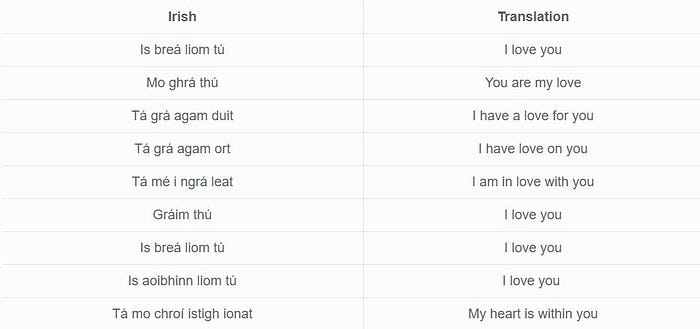
6 Other Sweet Ways To Say “I Love You” In Irish (For Every Kind Of Love)
There is actually no direct phrase or word that translates to I love you in this language. However, there are other romantic options, and our top 10 Iris ways are listed below.
Irish doesn’t just have one way to say “I love you” — it has layers. Depending on who you’re talking to and how you feel, you can choose a phrase that fits the moment perfectly.
2. Is breá liom tú
(I like you very much)
- Lighter, but still meaningful
- Perfect for when you’re not quite ready for “I’m in love”
- Often used before saying Tá mé i ngrá leat
2. Tá grá agam duit
(I have love for you)
- Gentle, sincere, and poetic
- Great for early-stage romance or heartfelt messages
- Literally: “There is love at me toward you”
3. Mo ghrá thú
(You are my love)
- Intimate and tender
- Sounds like a lullaby or love poem
- Use it in private moments or written notes
4. Tá tú i mo chroí
(You are in my heart)
- Romantic and visual
- A beautiful alternative to “I love you”
- Often used in songs and wedding vows
5. Grádhaim leat
(I love you — older, poetic form)
- Less common today, but deeply traditional
- Found in old letters and Gaelic literature
- Adds a timeless, classic touch
6. Tá tú mo shaol
(You are my life)
- Big, bold, and full of passion
- For when you’re all in
- Pairs perfectly with Tá mé i ngrá leat
And of course, we will not leave you to dry out on your own as we also have a few more practical, oh-so-sweet phrases and words that you can use related to your feelings. Some listed below can also be used as an expression, I love you too!
So, which of these sweet words are you going to use with your sweetheart? If you enjoyed this romantic post, feel free to read our other posts, like how to say happy birthday greetings. Feel free to share this on social media and help us reach other language enthusiasts out there!
How To Say “I Love You Too” In Irish
When someone says Tá mé i ngrá leat to you, here’s how to answer with your whole heart:
- Tá mé i ngrá leat freisin – I love you too
- Is breá liom tú freisin – I like you very much too
- Tá tú i mo chroí freisin – You are in my heart too
Say it with a smile. Say it with eye contact. Say it like you mean it.
Why Should You Learn The Irish Language?
Let’s be honest — you don’t learn Irish because it’s easy. You learn it because it’s meaningful.
The Irish language isn’t just a way to communicate. It’s a living thread connecting you to centuries of poetry, rebellion, music, and deep-rooted identity. With roots stretching back to the Ancient Celts and the earliest Ogham stones carved in the 5th century, Irish (or Gaeilge, as it’s called in the language itself) is one of Europe’s oldest living tongues.
Yes, English dominates daily life in Ireland today. And yes, only about 39.8% of the population can speak Irish fluently. But here’s what the stats don’t tell: Irish is not dying — it’s being revived.
From the windswept coasts of Donegal to the rolling hills of Galway, Kerry, and Mayo, the language still pulses through Gaeltacht communities where families raise their kids speaking Irish at home. Schools teach in Irish. Radio stations broadcast in Irish. Artists sing in Irish — and more people than ever are tuning in.
And guess what? You don’t have to be Irish to be part of this revival.
There’s something truly special about the sound of Irish — a melody all its own. Listen to native speakers, and you’ll hear soft lilts, rolling rs, and rhythms that feel almost musical. It’s no surprise learners often say it reminds them of Spanish, Italian, or even Arabic in its flow.
But beyond the beauty of how it sounds, learning Irish opens a door — not just to vocabulary, but to connection.
When you say Tá ocras orm (“Hunger is on me”) instead of “I’m hungry,” you’re not just learning grammar — you’re stepping into a different way of seeing the world. One where emotions, weather, and even hunger happen to you, not just in you. That’s not quirky — it’s poetic.
And when you try to speak it — even with an accent, even with mistakes — people notice.
You’re not just a tourist. You’re someone who cares.
So why learn Irish?
Because you love stories. Because you value culture. Because you want to keep an ancient language alive — not in a museum, but in real conversations, real hearts, and real moments.
It won’t happen overnight. Mastering the accent, the grammar, the nuances — that takes time. But every word you learn is a step forward. And with tools like the Ling app, you can start small, stay consistent, and actually enjoy the journey.
Because learning Irish isn’t about perfection.
It’s about showing up — and saying, “I care enough to try.”
How To Learn Irish — Even If You’re Starting From Zero
You don’t need to be Irish by blood to speak Irish. You just need heart, curiosity, and the right tools.
Here’s how to begin — for free, and at your own pace:
1. Start with Real Voices, Not Textbooks
Hear how native speakers say Tá mé i ngrá leat — not how it looks on paper. Pronunciation matters. Emotion matters more.
2. Learn in Context, Not Isolation
Don’t just memorize “I love you.” Learn when to say it, how it feels, and what it means in real life.
3. Practice Daily — Even for 5 Minutes
Consistency beats intensity. A little every day builds real confidence.
4. Use a Fun, Interactive App (Like Ling)
That’s where Ling comes in.
Ready To Say “I Love You” In Irish?
here’s something incredibly brave about saying “I love you” in another language.
You’re not just sharing feelings — you’re showing effort. Respect. Curiosity.
And when you say Tá mé i ngrá leat, you’re not just borrowing words from Ireland. You’re joining a living tradition of poetry, emotion, and deep connection.
So go ahead.
Practice the phrase.
Stumble over the sounds.
Then say it with your whole heart.
Because love doesn’t need to be perfect.
It just needs to be real.
Learn Irish With Ling — The App That Makes Learning Languages Fun And Easy
Ling isn’t another dry language course. It’s a joyful, interactive way to learn Irish — and over 70 other languages — from real native speakers.
Here’s what makes it different:
✅ Real voice recordings — no robotic text-to-speech
✅ Cultural notes — learn not just what to say, but why it matters
✅ Gamified lessons — fun quizzes, challenges, and progress tracking
✅ Free to start — learn basic phrases, pronunciation, and grammar with zero cost
✅ Perfect for beginners — whether you’re learning for love, travel, or heritage
You’ll learn phrases like Tá mé i ngrá leat with the right tone, timing, and tenderness — because they’re taught by people who’ve said them for real.
And the Ling app includes a free first lesson in the Irish course to help you start strong. Download and try today!