

Holi is the popular ‘festival of colors’ celebrated majorly in India and the Indian subcontinent. This fun holiday has its roots in Hinduism with deep spiritual undertones of revival, celebration of new beginnings, arrival of the spring and the victory of goodness over evil.
For me personally, Holi (होली) is hands down my favorite festival/ holiday in the world! Nothing beats the rush of having mad fun the entire day with your friends and family as you indulge in water gun fights, scrumptious food, and endless hours of dance and music!
The Holi festival in India is the ultimate welcome of Spring and that’s why it is aptly called the ‘Indian Color Festival’, or ‘Festival of Colors’. Its most popular form is celebrated in north and central India – the Hindi-speaking belt of the country. And just like other Indian holidays or festivals, it has dedicated folk songs in various dialects of the Hindi language which are the life of every Holi celebration.
So, let’s get acquainted with the ABCs of this fun Hindu festival of colors, along with a generous dose of Holi-related Hindi vocabulary and greetings. Cherry on the top? Top hit Holi songs of all time to add to your groovy playlist!
Holi Festival In India: Meaning, Traditions & Hindi Phrases
The main day of Holi, also known as Dulendi or Rangwali Holi, is celebrated on the Purnima (पूर्णिमा – full moon day) in the Hindu calendar month of Phalguna (फाल्गुन) or Phagun (फागुन), which typically falls in early March according to the Gregorian calendar. That is why the Holi festival is also known as Phag (फाग).
Holi celebrations often start with a ceremonial bonfire called Holika Dahan (होलिका दहन) the night before, where people gather around the fire and offer sesame seeds, dry coconut and wheat grains to the fire. This ritual signifies the victory of good over evil and is rooted in Hindu mythology.
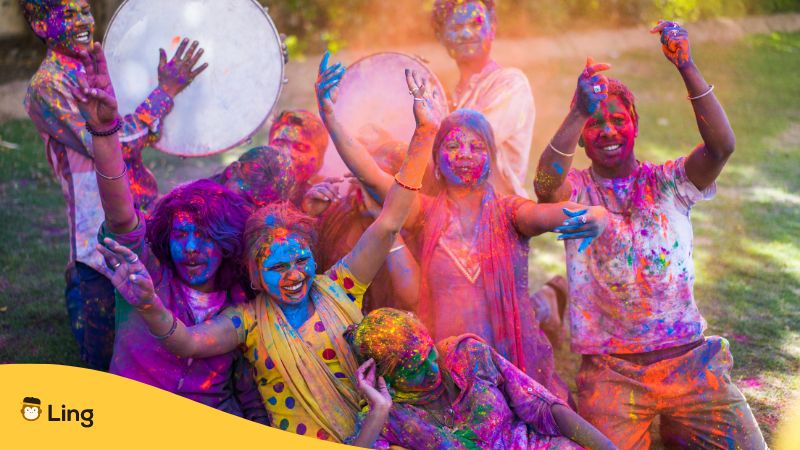
The next morning, the streets come alive with music, dance, and the riot of colors as people of all ages, religions, and backgrounds come together to celebrate. people take to the streets to play Holi, throwing colored powder called gulal (गुलाल) and colored water at each other, creating a vibrant and joyful spectacle. I remember how as a kid, I would look forward to playing Holi with my neighborhood friends without a care about the ongoing annual school examination, year after year.
Holi Greetings And Vocabulary In Hindi
| English | Hindi | Transliteration | Pronunciation |
|---|---|---|---|
| Happy Holi! | होली मुबारक! | Holi Mubaarak! | |
| Holi wishes | होली की शुभकामनाएँ | Holi ki shubhkaamnaaein | |
| Hearty Holi wishes! | होली की हार्दिक बधाई! | Holi ki haardik badhaai! | |
| Don’t mind, it’s Holi! (used when pranking your friends with color powders) | बुरा न मानो होली है! | Bura na maano Holi hai! | |
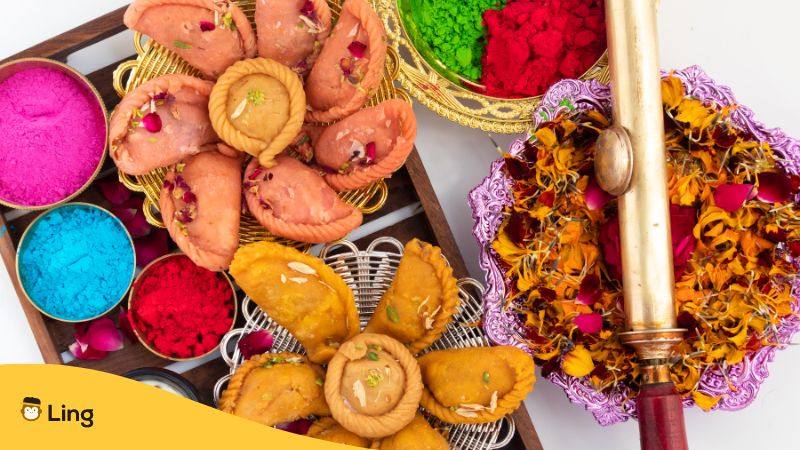
| Gulaal/ Gulal (powdered red/ pink color) | गुलाल | Gulal | |
| Powdered green color | अबीर | Abeer | |
| Water gun | पिचकारी | Pichakari | |
| Water filled balloons | पानी के गुब्बारे | Paani ke gubbare | |
| Holi fun | होली की मस्ती | Holi ki masti | |
| Spring | फागुन | Phagun |
Want to pronounce these Hindi phrases correctly and learn more festival vocabulary? Ling’s Hindi course teaches you real-life phrases with native audio and interactive practice.
Holi In India Explained: History & Rituals
Holi has its origins in Hindu mythology, particularly in the stories of Lord Krishna and the legend of Holika and Prahlad. According to one legend, the festival commemorates the victory of Lord Vishnu’s devotee Prahlad over his evil aunt Holika, who tried to kill him on a pyre. Lord Vishnu protected Prahlad, and Holika burned to death instead. This event is celebrated as Holika Dahan (burning of Holika) on the evening before Holi.
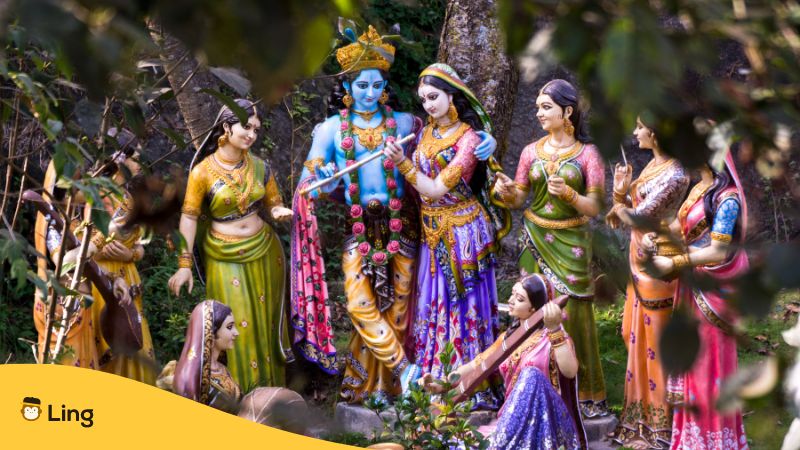
Another popular legend associates Holi with the love story of Lord Krishna, the butter thief (makhan chor), who playfully teased the gopis (female cowherds) by drenching them in colored water and covering them with colored powder. His eternal spiritual love with Radha, one of the gopis, is invoked and celebrated during Holi.
Celebrating The Spirit Of Holi
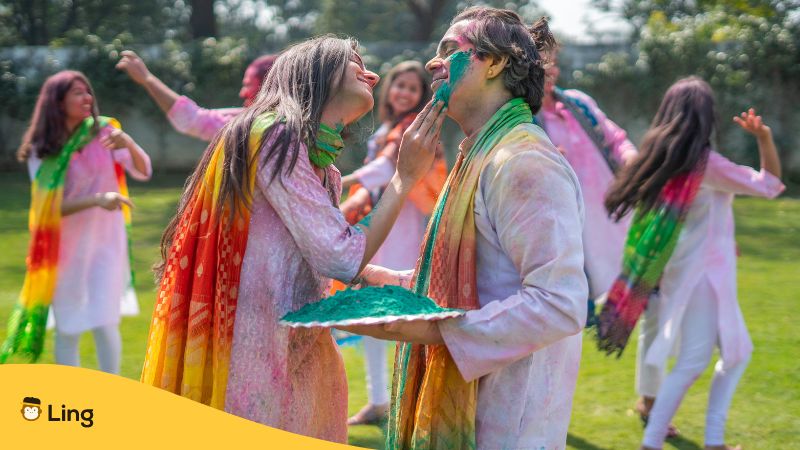
What is the spirit of Holi? How is Holi in India celebrated? On one hand while Holi is a community festival played out on the streets, it also has an undercurrent of young love and budding romance. Couples wait eagerly to smear each other with red gulal or drench each other with red/pink water – symbolizing getting drenched completely in each other’s love.
Regional Variations And Traditions Of Holi
India is a land of diversity. It’s not for nothing that the country is also referred to as a union of many different countries. However, the unique thread of “unity in diversity” keeps this chaotic land together as one nation and its many festivals keep the spirit of oneness and bonhomie alive throughout the year.
Holi Celebrations In North India
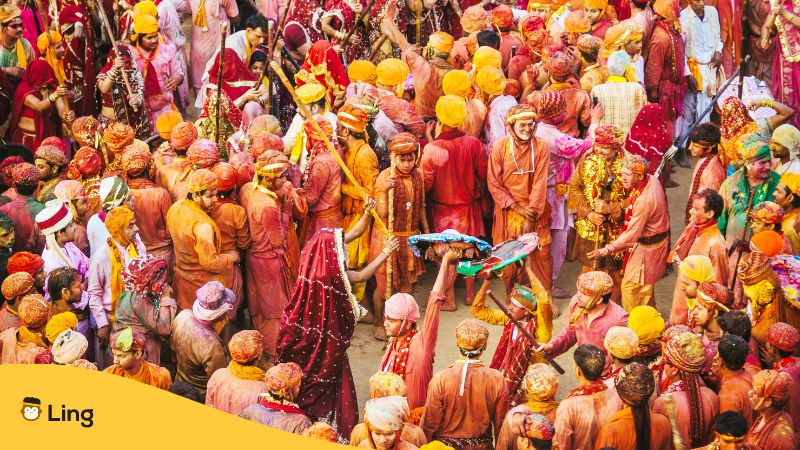
While the core essence of Holi remains the same across India, the celebrations and traditions vary in different regions. The Holi celebrated in Mathura and Vrindavan – the twin towns of Radha-Krishna’s youth – is the most popular across the country. In these towns in North India’s Uttar Pradesh, collectively called Braj region, the celebrations are more intense. People engage in the traditional Lath Mar Holi (लट्ठ मार होली) where women beat men playfully with bamboo sticks, symbolizing the playful relationship between Lord Krishna and the gopis.
In Punjab, particularly among the Sikh community, Holi is celebrated as Hola Mohalla (होला मोहल्ला). It’s marked by martial arts demonstrations, mock battles, and various other physical activities. It’s also a time for Sikhs to gather, pray, and celebrate.
Holi Celebrations In Central India
In Madhya Pradesh people celebrate Holi or Rangapanchami with rituals like Bhagoria and Gair. Bhagoria has significance as a harvest festival of the farmers.
Northeast And East India Holi
In West Bengal and Odisha, the festival is called Dol Jatra (डोल जात्रा) or Dol Purnima (डोल पूर्णिमा). People sing traditional Holi songs and perform dances around a decorated pole called the Dol Manch (डोल मंच).
In Odisha, people tale put a procession with decorated palanquins made in the structure of palaces, housing temple dieties. In Assam (Northeast India), Holi is called Phagwah or Phakuwa (फकुवा).
Holi Of The Coastal And West India
In the coastal regions, particularly in Mumbai and parts of rural Maharashtra, people celebrate Rang Panchami (रंग पंचमी) five days after Holi. They smear each other with colored powder and water, followed by feasting on traditional delicacies.
One important highlight of Rang Panchami is the jewelry made of sweets (aabhooshan mithai) that resembles a flower garland.
South India Holi Celebrations
In Karnataka, Holi is primarily celebrated in the northern parts of the state, especially in districts like Uttara Kannada, Belgaum, and Bidar. It is known as Kamana Habba or Kamadahana.
The Dance And Music Traditions Of Holi
The concept of Radha Krishna’s eternal love forms the underlying current of innumerable dance, music, and folk art traditions. A significant thing to note is that many Islamic Sufi saints of medieval India wrote poetry celebrating this spiritual oneness, which in Hinduism is revered as the merging of an individual soul (Radha) within the Divine (Krishna), thus leading to enlightenment or nirvana.
You have to listen to the evocative poetry in the Hindustani Classical music or folk songs, or a Kathak performance depicting this Divine Love. Hori is one of the light forms of Hindustani classical music sung during the festival of Holi. Songs of Hori/ Dhamar are related to Radha-Krishna Leela in the festival of Holi.
Rangi Saari Gulabi Chunariya Re (translation: my entire scarf has been drenched in pink) is one of the most popular Thumris (a type of semi-classical music genre) where Radha describes herself as being colored pink by Lord Krishna. This one song encapsulates the Holi romance perfectly.
The Popular Holi Delicacies
No festival is complete without festival-specific food in India. and Holi is no exception. Here’s a region-wise look at the most popular Holi treats.
Pan India favorites:
- Gujhiya (गुझिया) – Deep-fried sweet dumplings stuffed with khoya and dry fruits (the signature Holi sweet in many regions).
- Malpua (मालपुआ) – Pancakes soaked in sugar syrup.
- Dahi Vada (दही वड़ा) – Lentil fritters soaked in sweet and tangy yogurt.
- Thandai (ठंडाई) – A festive milk-based drink flavored with nuts and spices; sometimes infused with bhang (hemp) during Holi celebrations.
- Chaat – Savory street-style snacks commonly enjoyed during Holi gatherings.
Holi favorites in West Bengal:
- Roshogolla (रसगुल्ला) – Soft cottage cheese balls soaked in sugar syrup.
- Sondesh (संदेश) – Delicate sweets made from fresh milk solids.
Holi favorites in Maharashtra:
- Puran Poli (पुरण पोली) – Sweet flatbread stuffed with lentils and jaggery.
Holi favorites in South India:
- Obbattu / Holige – Regional variations of puran poli.
- Paruppu Payasam – A lentil-based sweet pudding (kheer).
These colorful sweets and festive drinks add just as much joy to Holi as the vibrant powders, because in India, celebrations are always incomplete without food!
Why Is Holi Celebrated In India?
Holi is celebrated in India to mark the victory of good over evil or righteousness over malice. More than being a fun-filled festival of colors, Holi is a celebration of love, forgiveness, and the renewal of life. Along with Diwali – the festival of lights, it is the most popular and significant Hindu festival in India. The vibrant colors are all about the vibrancy of life, and the act of applying colors to one another signifies the acceptance and embracement of differences. The festival also marks the end of winter and the arrival of spring, a time of new beginnings and hope.
For many, Holi is an opportunity to let go of inhibitions, forget grudges, and strengthen bonds with family and friends. It is a time to come together, dance, sing Holi songs, and indulge in traditional Holi delicacies like gujiya and thandai.
Another tradition associated with Holi is very similar to the April Fool’s Day – pulling pranks on each other. It’s not for nothing that the evergreen Holi phrase is “Bura na maano Holi hai!” (बुरा न मानो होली है!) which means, “Don’t mind, it is Holi!” Friends, cousins, and siblings hatch elaborate plans days in advance to get one over each other.
For literary-inclined people, Holi is the perfect opportunity to get together and recite parodies and poetry laced with comedy and puns for a fun time together. These events are called haasya kavi sammelan (congregation of comic poets).
Significance Of Holi: Embracing Diversity And Inclusivity
While Holi is primarily a Hindu festival, its spirit of joy and inclusivity has transcended religious boundaries. In many cities and towns across India, non-Hindus also participate in the celebrations, making it a true celebration of unity and diversity.
In recent years, Holi parties and events have become increasingly popular, with people organizing water gun battles, music festivals, and dance parties to celebrate the festival in their unique ways. And you know what? Bollywood rules the roost in all these Holi bashes.
Popular Holi Songs
DJs across the country belt out chartbusters after chartbusters from Bollywood’s treasure trove of Holi songs to keep every person – age no bar – on their feet throughout the day. Here is the list of the top 5 popular Holi songs that you’ll hear at every Holi house party or commercial Holi bash.
- Holi Aayi Re by Coke Studio Bharat: This is the most trending Holi song right now. Reason? It’s a folk fusion song that depicts the Holi revelry through a mix of a folk song and rap battle set against Indian musical instruments.
- Rang Barse Bheege Chunarwali: This is the ultimate Holi anthem. No Holi celebration is complete without this iconic song from the Hindi movie Silsila released in the 1970s blaring in a loop.
- Balam Pichkari: This is the new age ‘It’ song for Holi with groovy beats and peppy lyrics.
- Holiya Mein Ude Re Gulal: This folk song from Rajasthan sung in the rustic and throaty voice of folk artist Ila Arun is an iconic Holi song that forces you to get up and dance!
- Badri Ki Dulhaniya: This song is a visual treat with a Holi backdrop and some groovy steps by the lead pair. Do check it out!
The list would be incomplete without the mention of my favorite Holi song by Sufi poet Amir Khusro – Aaj Rang Hai Ri Maa.
Top 6 Best Tourist Places To Celebrate Holi In India
Here is a list of the top 6 cities which are popular for their vibrant Holi celebrations.
- Mathura-Vrindavan-Barsana: The twin cities of Mathura and Vrindavan are considered the epicenter of Holi celebrations. As the birthplace of Lord Krishna, these cities come alive with colorful celebrations reenacting the divine love between Radha and Krishna. The famous Lath Maar Holi is played here with great fervor.
- Jaipur or Udaipur, Rajasthan: Holi in the Pink City of Jaipur is popular for its grand celebrations hosted by royal families in magnificent palaces. Similarly, Udaipur (City of Lakes), one of the most romantic destinations in India – royally celebrates Holi with folk music and dance performances, adding to the festive spirit.
- Banaras, Uttar Pradesh: In Banaras – also known as Varanasi, the festivities take on a unique and sacred tradition of Masan Holi, where Holi is played with pyre ashes. This tradition during Holi implies a deep-rooted religious and cultural importance that intertwines the celebration of colors with spiritual reverence. This oldest living city from ancient India swears by Lord Shiva – the god of destruction and this specific ritual has undertones of accepting life’s eternal reality – death.
- Pushkar, Rajasthan: Pushkar is a popular choice among tourists when it comes to having a good time. The Pushkar Lake, situated bang in the middle of the town, comes alive with fun and revelry as people play Holi in its color-splattered by lanes.
- Anandpur Sahib, Punjab: Hola Mohalla, the Sikh version of Holi, is celebrated with great zeal in Anandpur Sahib. It is a deeply symbolic festival that combines the ethos of valor and unity. Impressive displays of martial arts, poetry, and music mark these celebrations.
- Shanti Niketan, West Bengal: The quaint town of Shanti Niketan, established by Nobel Laureate Rabindranath Tagore, celebrates Holi with a touch of culture and creativity. The students of Visva-Bharati University organize cultural programs with music, dance, and plays based on spring festivities.
Tips To Celebrate Holi Festival
Here are 10 tips for tourists to celebrate Holi in India:
- Choose your location wisely – Popular destinations like Mathura, Vrindavan, Barsana, Pushkar, Banaras, and Anandpur Sahib start gathering crowds a week prior to Holi as these places offer the most immersive Holi experiences. Make sure you are able to handle being jostled in a crowd before you step foot into one of these top destinations.
- Wear clothes you don’t mind getting stained – The vibrant colors are sure to leave marks, so opt for light or bright-colored clothes made of cotton that you wish to discard already. But if you are feeling really filmy (Indian slang for a Bollywood movie buff), you can step out in your finest whites, just like Bollywood actors!
- Protect your valuables – Keep your cameras, phones, and other valuables safely wrapped or leave them behind during the color play as you are sure to get drenched as soon as you step out into the streets.
- Apply oil – Apply a generous amount of oil or moisturizer to your hair and skin to prevent the colors from sticking too much.
- Join the fun but safely – Don’t be a mere spectator. Embrace the spirit of Holi and participate in the color play with enthusiasm. But maintain caution. Only hang out with your Indian friends or acquaintances or attend Holi parties hosted by popular platforms.
- Respect boundaries – While the festival is joyous, be mindful of personal boundaries and consent when smearing colors on others. Also, do not hesitate to protect your own boundaries as well. Remember, Holi is an occasion where boundaries can get easily blurred so be mindful.
- Try the delicacies – Indulge in the traditional Holi delicacies like gujiya, thandai, and many flavorful chaats to savor the flavors of the festival. But again, be cautious as sometimes, these items might also come with a pinch of bhang (cannabis) infusion.
- Learn the traditions – Attend the Holika Dahan ceremony, witness the Lath Maar Holi, or join the local cultural programs to experience the rich traditions. To enjoy the max, learn some basic Hindi phrases using the Ling app.
- Be prepared for crowds – Popular Holi destinations can get extremely crowded, so plan your transportation and accommodation accordingly.
- Capture the memories – Take plenty of pictures and videos (with consent) to cherish the vibrant and joyous memories of your Holi celebration in India.
FAQ: Holi In India
What Are The 2 Days Of Holi?
The two days of Holi are Holika Dahan (the evening bonfire) on the first day and Rang wali Holi on the second day morning when people smear each other with colored powders. The fire signify burning all the evils within into the Holika fire and purging oneself. The second day signify embracing the colors of life.
Who Celebrates Holi And Why?
Holi is celebrated by Hindus in many parts of India, especially North, North west and central India, along with members of the Indian diaspora across the globe. The festival of Holi is celebrated to mark the victory of goodness over evil, while emphasizing on the spirit of spiritual renewal. The festival of colors also celebrates bonhomie, arrival of spring and the joyous essence of a vibrant life.
Why Do They Throw Colors At Holi?
Colors signify the vibrancy and joy. That’s why people in India celebrate Holi by smearing each other with bright colors – a beautiful way of wishing verve and happiness to each other. It is a very physically affectionate way of saying, “May your life be filled with color,” while smearing fragrant colored powders on each others’ faces.
Which Country Invented Holi?
Holi celebrations were started in the Indian subcontinent and has its roots in the Hinduism or the Hindu religion. However, today, Holi has found global relevance with Holi parties being a grand affair around the world, thanks to the Indian diaspora.
Holi: A Lasting Impression
For those who have witnessed or participated in the Holi celebrations, the experience is truly unforgettable. The vibrant colors, the infectious energy, and the spirit of love and togetherness leave a lasting impression on the hearts and minds of all who partake in this special event.
As the world becomes increasingly connected, the festival of Holi has also gained global recognition, with people of Indian origin and those inspired by the cultural richness of India celebrating the festival in different parts of the world.
So, whether you’re a lover of an Indian sweetheart, or Indian culture, a traveler in India seeking unique experiences, or someone looking to embrace the spirit of joy and inclusivity, Holi in India is an experience that should be on your bucket list. Immerse yourself in the colors, the music, and the energy of this ancient festival, and let the spirit of Holi fill your heart with love, forgiveness, and the zest for life.
Master The Hindi Language In A Fun Way With Ling!
Now that you are all prepared to participate in the Holi celebrations in India, why not do things properly by also learning Hindi greetings? The best way to do so – as a traveler – is to have a handy pocket guide in the form of a language learning app.
Which one, you ask? Try Ling! The Ling app is one of the best apps to learn Hindi. It is gamified and has a convenient AI chatbot to practice your conversation skills. But the biggest flex is the audio lessons recorded by native Hindi speakers so that you can actually “hear” how the Hindi language sounds in real time. So go to your App Store or Play Store and download the Ling app right now!