


Let’s learn some poetic Tagalog words with Ling!
Tagalog is a beautiful language. And one thing that makes it unique is its set of poetic words, such as ‘kilig’ and ‘bayanihan,’ which we will learn today.
We’ll start by learning some ways to say ‘beautiful,’ then explore over 20 poetic Tagalog words that showcase the beauty of the language. We’ll then, of course, give you some tips to remember and use the new vocabulary, along with some extra words worth knowing.

So, keep reading below!
What Is The Tagalog Word For Beautiful?
Poetic Tagalog words are simply beautiful, so before we go over the top words, let us first learn how to say the word beautiful in the Filipino language.
Filipinos usually use the word maganda (beautiful) in most situations. You can use it to describe a person, thing, place, and more. However, Filipinos also use the following terms:
| English Translation | Tagalog | Sound |
|---|---|---|
| Beautiful/Gorgeous/Lovely | Marikit | |
| Beautiful/Magnificent | Marilag | |
| Beautiful/Desirable/Likable/Enchanting | Kaibig-ibig/Kaaakit-akit |
|
| Bewitching beauty/Captivating | Nakabibighani |
Filipinos use these essential words to say ‘beautiful’ in their language.
The meaning of these words may be the same, but they are used in different situations and contexts.
These beautiful Tagalog words are a must memorize to impress your Filipino friends!
More Poetic Tagalog Words
Another reason why these Tagalog words are considered beautiful is that they are uncommonly used in casual conversations.
With continuous modernization and globalization, some Filipinos no longer know the meaning of these words. So when you hear these words, it is music to the ear.
Luckily, some people, like writers, songwriters, teachers, etc., still fight to preserve them.
You can see many of these poetic Tagalog words on social media, like those usually pinned on the free Pinterest app. You can go to Pinterest, log in, and search for these words.
These words will also be shared with people wherever they are, even if their first language is not Filipino.
If you want to expand your vocabulary with poetic Tagalog words, here’s a list to start with. You will learn the words and the culture and history behind what made them uniquely beautiful.
1. Bayanihan (Communal Unity)
- Example Sentence: Nakita ang diwa ng bayanihan ng mga Pilipino dahil sa community pantry noong pandemya. (The spirit of communal unity was seen because of the community pantry during the pandemic.)
The most beautiful poetic Filipino word is Bayanihan, the spirit of cooperation and communal unity. This is one of the words that are truly valuable in Filipino culture.
Bayanihan is one of the greatest Filipino values that can still be seen even today.
The most famous picture of these values is the lipat-bahay, where Filipino people lift a bahay kubo (a traditional Filipino house) to relocate. This culture turns an ordinary person into a real-life hero.
2. Kilig (Feeling Of Exhilaration Or Elation)
- Example Sentence: Hindi ko mapigilan ang aking kilig nang makita ko siya. (I couldn’t help but feel exhilarated/elated when I saw him/her.)
Have you ever felt butterflies in your stomach when you see the person you like or love? This is what ‘kilig’ feels like, although there’s no direct translation of this word in English.
It’s the feeling of exhilaration or elation one experiences in romantic or exciting situations, for example, when an Army met the BTS or when a “Swifty” met Taylor Swift.
3. Harana (Serenading)
- Example Sentence: Uso pa ba ang harana? (Is serenading still in style?)
Harana is the traditional way of courting someone. It is when the suitor is wooing the person they like by serenading.
Back in the old times, only the guys did this in front of the girl’s house with their instruments and some backup. The girl will just look out her window.
This is one of the popular ways of old-style courtship that will never fail to make your heart race. Nowadays, you can also see girls serenading boys.
4. Kundiman (Traditional Filipino Love Song)
- Example Sentence: Palagi kitang aawitan ng kundiman. – (I will always sing you a traditional love song.)
In connection to harana, kundiman is also a word you must learn. Kundiman is a love song. This is the song that guys sing and play in a harana.
One of the classical Kundiman is Bituing Marikit (1926) by Nicanor Abelardo.
The Philippine art song, kundiman, originated during a movement against Western musical traditions in the late 19th and early 20th centuries.
The genre, which portrays courting and undying love, served as a platform for regaining Filipino nationalist identity.
Composers like Francisco Santiago and Nicanor Abelardo were instrumental in its development.
They created songs that drew inspiration from traditional folk melodies as a form of cultural expression and resistance against Spanish and American influences.

5. Tinatangi (Special Someone)
- Example Sentence: Mayroon na akong titanatangi. (I already have a special someone.)
One of the sweetest things in life is knowing that you are somebody’s tinatangi or special someone.
Filipinos use this word to refer to their special someone, and you’ll mostly hear this during courtship.
The word tinatangi came from the root word tangi, which means one or one and only. So, if someone says Ikaw ang aking tinatangi. It means that you’re their only one.
6. Kaulayaw (Intimate Companion)
- Example Sentence: Nag-usap sila ng kaniyang kaulayaw sa asotea. (She talked with her intimate companion on the balcony.)
Kaulayaw came from the word ulayaw, which means intimate conversation. Given this, kaulayaw means a pleasant and intimate companion.
In one of the Philippines Obra Maestra called Noli Me Tangere, a chapter called “Pag-uulayaw sa Asotea” where Maria Clara and Crisostomo Ibarra talked in the asotea or balcony.
They reminisce the memories of their relationship while being away from each other for a long time.
This scene is what traditional Filipino courtship and relationships look like.
The guy visits the girl at her house. Nowadays, this culture is not strictly practiced, especially in urban areas like Manila.
However, old-fashioned parents still want to keep it this way, especially in rural areas.
7. Paraluman (Goddess/Muse)
- Example Sentence: Paraluman, ika’y akin nang dadalhin sa ‘di mo inaasahang paraiso. – (Paraluman, I’ll take you to an unexpected paradise.)
- “Kamukha mo si Paraluman noong tayo ay bata pa.” – (You looked like Paraluman when we were young.)
Filipinos will choose to sing the line above rather than simply read it. Why?
It’s because it came from a very popular Filipino song called “Ang Huling El Bimbo” by Eraserheads, where they mention paraluman, a Filipino-German actress. Her name is Sigrid Sophia Agatha von Giese.
They use the word paraluman there is used to refer to a very attractive woman.
In the early nineteenth century, Filipino poets used paraluman to describe a muse or a woman who inspires creativity.
It’s also an antiquated Tagalog word for magnetic needle, which functions similarly to a compass. In this sense, the term paraluman is no longer used.
In the concept of being a particularly attractive female, a paraluman can also mean “goddess.”
If you want a more relatable illustration of the term, you may listen to the song Paraluman by Adie. Turn on the subtitles to understand the lyrics. You can also hear a lot of beautiful Tagalog words in this song.
8. Makisig (Handsome/Dashing)
- Example Sentence: Isang makisig at mabuting-loob na binata ang gusto niya. (She likes a handsome and kind-hearted man.)
Have you seen a dashing, handsome, smart, and refined man? In Tagalog, the word for that is makisig.
This might be the kind of man some Filipinas want, but of course, they are not always looking for someone handsome. Back in the old times, the man was expected to prove his love and worth to the woman’s parents before marrying her. This is something that dating apps cannot do nowadays.
9. Tadhana (Destiny/Fate)
- Example Sentence: Ang tadhana ang nagdala sa atin sa isa’t isa. (Destiny brought us together.)
There are things in life that we can’t control. Whether we like it or not, these things are meant to happen because it’s our tadhana. The Tagalog word tadhana is an unseen power that causes events beyond mortal control.
10. Gunita (Memory/Recollection)
- Example Sentence: Ang ating mga gunita ay mananatili sa aking puso. (Our memories will always be in my heart).
Do you have a fond memory or recollection that you cherish dearly? The Tagalog word for that is gunita. Nowadays, you’ll often hear this word in songs, stories, and poems. People don’t always use this in casual conversations.
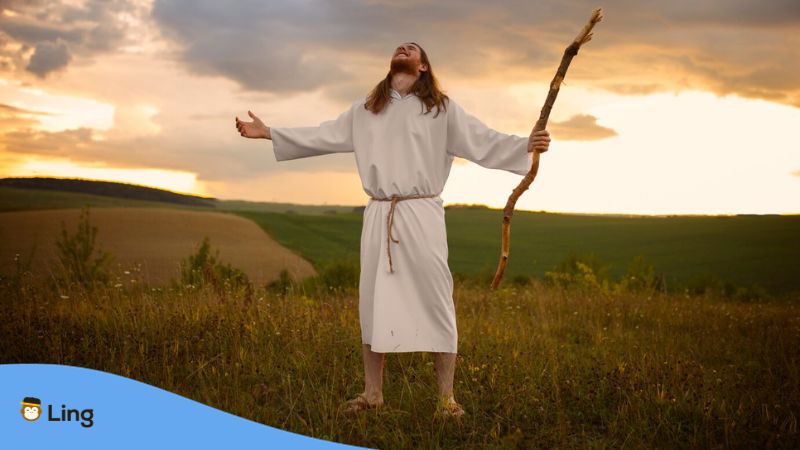
11. Bathala (Supreme Being/God)
- Example Sentence: Noong nakita kita sa tagpuan ni Bathala may kinang sa mata na di maintindihan. – Tagpuan by Moira (When I saw you in God’s meeting place with a spark in your eyes I can’t understand.)
Christianity arrived in the Philippines during the Spanish colonization. Before that, ancient Filipinos used to worship deities.
Like Romans and Greeks, Filipinos also have mythology, and Bathala is the Supreme Being, the creator and ruler of the cosmos, based on the old Tagalog indigenous religion.
12. Amihan (Northeast Wind)
- Example Sentence: Madarama ang Hanging Amihan sa Pilipinas mula buwan ng Oktubre hanggang Disyembre. (The Northeast Monsoon can be felt in the Philippines from the month of October to December.)
Amihan is the word locals use to refer to the Northeast wind. Interestingly, it is also the name of the goddess of wind in the hit Filipino fantasy series Encantadia.
13. Timpi (Self-Control/Restraint)
- Example Sentence: Kahit ako ay sobrang galit na, pinilit ko pa ring magtimpi. (Even if I am really angry, I chose to control myself.)
Have you ever experienced being too annoyed, angry, or excited, yet you managed to remain calm? The Tagalog word for that is timpi. It is also used in the context of controlling oneself under challenging situations.
14. Tampo (Sulking/Withdrawing Affection)
- Example Sentence: Nagtatampo ang aking kasaintahan dahil hindi ako nakapunta sa aming usapan.(My girlfriend is sulking because I failed to make it in our date.)
There is no exact translation of this word in English, though “sulking” or “to sulk” is frequently considered the closest.
Tampo is a term used in Philippine culture to describe various behaviors in which someone withdraws their affection or cheerfulness from someone who has hurt their feelings.
15. Bughaw (Blue)
- Example Sentence: Ang kulay bughaw sa watawat ng Pilipinas ay sumisimbolo sa kapayapaan at katarungan. (The blue color in the Philippine flag stands for peace and justice.)
One of the most common mistakes that even locals commit is referring to the color blue as asul. The word asul is not the Tagalog translation of blue because it is a Spanish word.
The correct translation is bughaw. It is one of the most significant colors for Filipinos. It’s in the Philippine flag and also mentioned in the Philippine National Anthem.
16. Gigil (Overwhelming Urge To Squeeze)
- Example Sentence: Nanggigil ako sa bagong aso namin. (I can’t stop myself from squeezing our new dog.)
Have you seen a baby so cute that you want to pinch its cheeks? This is what gigil feels like. It is an intense desire to squeeze something.
It can also be an uncontrollable urge to touch someone caused by overwhelming emotions like admiration and anger.
For example, your mom is really angry with you for talking back while she scolds you. Then she says, “Nanggigigil ako sa’yo,” which can mean, “I’m controlling myself not to lay hands on you right now.”
Did you know? Gigil is one of the untranslatable Tagalog terms that is popular globally.

17. Muni-Muni/Magmuni-Muni (To Ponder/Meditate)
- Example Sentence: Umakyat ako ng bundok upang magmuni-muni tungkol sa mga bagay sa buhay. (I climbed a mountain to meditate on the things in life.)
If things are getting overwhelming or you have to think about your decisions in life, you’ll meditate or ponder. In Tagalog, that’s what magmuni-muni means.
18. Alpas (To Break Loose/Free)
- Example Sentence:Nakaalpas na ako sa pagkakatali sa aking madilim na nakaraan. – (I have broken loose from being tied to my dark past.)
We tend to be overwhelmed with problems in life, and we want to escape or free ourselves from that situation.
Filipinos use the word alpas in this situation, which can literally and figuratively mean becoming free or breaking loose.
People don’t use this word in casual conversations. You often hear them use laya/lumaya. But laya generally refers to the state or condition of being free.
It’s a broader term that can refer to various kinds of freedom, from physical to abstract.
As for alpas, it paints the image of doing everything you can to break loose.
It symbolizes one’s effort to escape from a difficult situation. In some contexts, alpas can be synonymous with laya, but they convey different nuances of freedom.
19. Pagsamo (Pleading/Begging)
- Example Sentence: Sana’y pakinggan mo ang aking pagsamo. (I hope you listen to my pleading.)
Pagsamo or pleading is another level of asking for something.
It is near to begging, where you are willing to give all of yourself. Filipinos do not use this in casual conversations.
But you’ll often hear this in songs and movies, making everything better and more emotional.
20. Habilin (For Safekeeping/Bequest)
- Example Sentence: Inihabilin sa akin ng aking ina ang mga alahas na ito. (My mom entrusted these pieces of jewelry to me for safekeeping.)
Habilin is something that’s been provided to someone for safekeeping. It can be material things like money and jewelry. It can also be people, and it can also be a secret.
When given a habilin, you must do your best to protect and keep it safe.

21. Silakbo (Emotional Outburst)
- Example Sentence: Nagpadala ako sa silakbo ng aking puso at inamin kong mahal ko siya. (I gave in to an emotional outburst, and I confessed my love for him/her.)
When we become emotionally overwhelmed, we tend to have a sudden emotional outburst.
Sometimes, we say things we don’t mean because of our emotions. In Tagalog, this is called silakbo.
22. Siping (Lying Beside Intimately)
- Example Sentence: Natulog kami nang magkasiping. (We slept together side-by-side intimately.)
This Tagalog word is tricky because siping means to lie down beside, to place by the side, but it usually includes an intimate partner.
If you want to indicate lying down beside, just use ‘magkatabi’ (lying side-by-side or next to each other) because siping is culturally understood to have intercourse.
23. Marahuyo (To Be Enchanted)
- Example Sentence: Baka marahuyo ang mga tao kay Pia Wurtzbach. (The people might be enchanted by Pia Wurtzbach’s beauty.)
Have you ever been enchanted by someone? It’s like they have taken you to another world, and it seems like you lost yourself because you’re completely enchanted.
Filipinos call this marahuyo in Tagalog. Just think about Taylor Swift’s song entitled Enchanted.
24. Humaling (To Be Captivated/Enthralled)
- Example Sentence: Sa unang tingin, agad na nahumaling sa nagniningning mong mga mata. (At first glance, I was immediately captivated by your glittering eyes.)
Humaling is an extreme fondness for something or someone. It gives you the feeling of being extremely captivated. It can also give you the feeling of being addicted to something, which makes you want to do it repeatedly.
25. Sapantaha (Hunch/Presumption)
- Example Sentence: Ang lahat ng mga sinabi ko ay pawang sapantaha lamang. (Everything that I said is based on a hunch only.)
Sapantaha is a hunch or presumption. It is a deeper word for hula or guess. You’ll seldom hear people saying it. But you’ll often see this in books and stories and hear it in movies and songs.
26. Pahimakas (Last Farewell)
- Example Sentence: Nagsagawa ng pahimakas ang mga mag-aaral sa kanilang guro. (The students bid their last farewell to their teacher.)
Learning this deep Tagalog word is the best way to end this list because ‘pahimakas’ means the last farewell in Tagalog.
It is seldom used in casual conversations, but it’s a popular title for closing parties in school.
How Do You Say Poetic In Tagalog?
To say poetic in Tagalog, you can just say matulain , which describes the character of a Filipino person.
You can also use the word patula , another Tagalog adjective.
Other Poetic Tagalog Words To Memorize
The Tagalog language is indeed a beautiful language to learn. Although most Filipinos nowadays know how to speak English, it is still important to keep the language alive.
Luckily, most OPM writers and singers nowadays use these words in their lyrics. You might not hear most of these words often, but knowing about them wouldn’t hurt.
Below are other beautiful and unique Filipino words that you might want to add to your vocabulary:
| English Translation | Tagalog | Sound |
|---|---|---|
| Clouds | Alapaap | |
| Charm/Allure | Alindog | |
| Doubt | Alinlangan | |
| Nurture | Aruga | |
| Mercury (Element) | Asoge | |
| A priestess | Babaylan | |
| Rainbow | Bahaghari | |
| Grammar | Balarila | |
| The pupil of the eye | Balintataw | |
| Glimpse/Faint Manifestation | Banaag | |
| A woman/Miss/Young lady | Binibini | |
| Star | Bituin | |
| Sunrise | Bukang-liwayway | |
| Spark/Electricity | Dagitab | |
| World | Daigdig | |
| Grief/Sorrow | Dalamhati | |
| Seashore | Dalampasigan | |
| Prayer | Dalangin | |
| Pure | Dalisay | |
| Princess/Noble lady | Dayang | |
| A spirit, usually a lesser god or goddess, who is thought to protect natural features | Diwata | |
| Female fairy | Engkantada | |
| Mythical environmental spirits that are believed to appear in human form | Engkanto | |
| Joy | Galak | |
| Loneliness/Melancholy | Galimgim | |
| A loud and uninhibited laughter (LOL) | Halakhak | |
| Appointed | Hirang | |
| The fruit of one’s dreams/Wishes and aspirations | Hiraya/Hiraya Manawari |
|
| Atmosphere/The air up there | Himpapawid | |
| Premonition | Hinagap | |
| To groove/To dance in time with the music | Indak | |
| Dear one/Beloved | Irog | |
| Freedom | Kalayaan | |
| Serenity/Tranquility | Kalinaw | |
| Knowledge | Kinaadman | |
| Muse | Lakambini | |
| Paramount Ruler | Lakan | |
| Intense tenderness and affection | Lambing | |
| Secret | Lihim | |
| To make something using your intellect and abilities | Likha | |
| Tears | Luha | |
| Noble | Maharlika | |
| Intractable/Elusive/Untamed | Mailap | |
| Peaceful | Payapa | |
| Affection | Pagsuyo | |
| Challenge/Obstacle | Pagsubok | |
| Worth it/Worth the effort/Worth the wait | Sulit | |
| Old-fashioned word for love or loved one | Sinta | |
| Home | Tahanan | |
| Sunset | Takipsilim | |
| Star | Tala | |
| Wicked/Scoundrel | Tampalasan | |
| Lover’s quarrel | Tampuhan | |
| A critical change or transition / development of a story or phenomena | Yugto |
Have you ever thought of memorizing them in just one go? It maybe hard right? But, there’s an easier way to do it.
Try learning through the Ling app now and discover more ways to learn a new language.
Tips To Memorize And Use These Poetic Tagalog Words
Did you notice how often many of these Tagalog words are also rarely used Tagalog words? Some of them are also deep Tagalog words. That can be hard on your Tagalog pronunciation lessons, right?
Worry not, here are some of the tips to fully maximize your time and effort to speak like a Tagalog local.
- Understanding poetic Tagalog words doesn’t require you to know intermediate or advanced Tagalog grammar. Some of these words are easy to memorize, too!
- Make use of memory devices or other memory techniques for language learning. Here’s one suggestion: Kinesthetic memorization. This involves actively listening and immersing yourself in using these words in your daily conversation.
- Don’t be afraid to make mistakes. It’s best that you’re aware of your next steps and strategies for Tagalog language learning.
- Start with the shorter poetic Tagalog words and then replace them with the basic or common Tagalog words you’ve learned. Then move on to the harder-to-pronounce and longer Tagalog words.
- Don’t worry about looking back at your beginner Tagalog language notes. It’s still useful!
Of course, everyone has their own strategy for memorizing. So, work out what’s best for you. There are many ways to incorporate Tagalog into your daily life.
But our best suggestion (that always works) is to engage in a conversation with a Tagalog native speaker.
Frequently Asked Questions About Poetic Tagalog words
What Are The Most Commonly Used Poetic Tagalog Words?
Here’s a list of words that Filipinos use when they want to sound poetic in Tagalog:
1. Hiraya
2. Kundiman
3. Aruga
4. Dalisay
5. Alapaap
6. Nakakapagdamdamin
7. Nakakapagpabagabag
What Is The Meaning Of Sinag?
Sinag is a Tagalog word meaning ‘the ray of light from the sun.’ It is also another Tagalog word for a beacon or a beam of light from an object.
For example:
The sun is shining so brightly today. – Mataas ang sinag ng araw ngayon.
I am seeing the beacon coming from the lighthouse at the seaside. – Nakikita ko ang sinag ng parola sa dalampasigan.
How Do I Learn Poetic Tagalog Words On My Own?
To learn Poetic Tagalog words on your own, have a language learning app like Ling to guide you.
However, you must first have a reason to say poetic Tagalog words. It is an uncommon thing to speak deep or poetic words in general. So, if you’re learning this lesson for your Filipino exam or to impress someone you met, take time to memorize these words in this article.
What Other Deep And Poetic Tagalog Words Should You Know?
Now that you’re well-prepared to take the next step in your Tagalog language level, use the lessons you’ve understood earlier.
It will be sulit (worthwhile) for you to take the next yugto (chapter/transition) to your language journey.
Try this sentence and decode what it means:
Hindi pa ito ang pahimakas ng pagaaral ko sa salitang Tagalog.
Let us know the Tagalog translation in the comments!
These poetic Tagalog words are just a few reasons the Tagalog language is exciting to learn. But you can’t see its beauty when you don’t try to learn this language.
Given all the influences of foreign languages, learning Tagalog isn’t that hard at all. In fact, you can learn it in a fun, engaging, and meaningful way.
Become A Pro In Tagalog Language Now!
With all the fun stuff in the Ling app, you might be missing out on what could be the best possible language learning app for your memorization needs.
What is inside the Ling app to help you improve your Tagalog vocabulary? First, you’ll find the handy review tab for all the words you’ve just learned.
You can easily browse which words you had a hard time with and then do the example quizzes or games again.
It also applies the SRS (Spaced Repetition System) technique for flashcards.
The catch is you’ll have longer and also intermediate to advanced Tagalog vocabulary as you go along the units and lessons.
As an intermediate or advanced learner, you will definitely need an app that will be on par with your goals.
So, if you want to learn the Tagalog language efficiently, download the Ling app on your phone or tablet now!