

Thailand has four major dialects: Standard Thai (Central), Northern Thai (Kam Mueang), Northeastern Thai (Isan), and Southern Thai (Pak Tai). Each variety features distinct vocabulary, tones, and pronunciation patterns. According to the 2025 National Population Census, approximately 70.3 million people speak these varieties[1], with Isan being the most widely spoken regional dialect at 33% of the population (roughly 20-23 million native speakers), followed by Northern Thai at 11% (6 million speakers), and Southern Thai at 9% (4.5-6 million speakers)[2].
While Standard Thai serves as the official language for education and government, regional dialects remain the primary language of daily life for most Thais. The word for “speak” perfectly illustrates this diversity: พูด (pûut) in Standard Thai, อู้ (ûu) in Northern Thai, เว้า (wáao) in Northeastern Thai, and แหลง (lɛ̌ɛng) in Southern Thai—completely different words with no shared sounds.
Who is this guide for?

Whether you’re an expat settling into Thai life, a student planning to study abroad in Thailand, a traveler exploring Thailand’s diverse regions, a heritage learner reconnecting with your roots, or a language enthusiast curious about linguistic diversity, understanding Thai dialects will transform your experience.
This guide breaks down the four major varieties, showing you exactly how they differ and where they’re spoken, helping you communicate more authentically and appreciate Thailand’s rich culture.
How Many Thai Dialects Are There?
Thailand officially recognizes four major regional dialects, though linguists have documented 51 living indigenous languages across the country, according to Ethnologue data[2]. The four primary varieties—Central, Northern, Northeastern, and Southern Thai—all belong to the Southwestern Tai branch of the Kra-Dai language family, sharing ancestral roots with Lao, Shan, and several languages in southern China[2].
Speakers of different regional varieties often struggle to understand each other without prior exposure. This linguistic distance is comparable to the difference between Spanish and Portuguese, leading some linguists to classify them as separate languages rather than dialects. However, the Thai government promotes a unified national identity, officially treating regional varieties as dialects of a single Thai language.
The designation as “dialects” versus “languages” is largely political. Most Thais grow up learning their regional variety at home while mastering Standard Thai through formal education, creating a bilingual or bidialectal population.
What Are The Top 4 Dialects Spoken In Thailand?
The linguistic landscape of Thailand centers on four distinct regional varieties, each tied to specific geographic areas and cultural identities:
1. Standard Thai (ภาษากลาง – Phasa Klang)
Standard Thai serves as the official national language, spoken natively by 20-27 million people in the central plains and the Bangkok Metropolitan Region. Nearly 96% of Thailand’s population is proficient in Standard Thai as either a first or second language[2], making it the lingua franca for all formal communication.
2. Northeastern Thai Or Isan (ภาษาอีสาน – Phasa Isan)
Isan dominates the twenty provinces of Northeastern Thailand and is essentially a group of Lao dialects. With 15-23 million native speakers, Isan represents the largest regional dialect community and accounts for roughly one-third of Thailand’s total population.
3. Northern Thai Or Kam Mueang (ภาษาเหนือ – Phasa Nuea)
Kam Mueang is the legacy language of the ancient Lanna Kingdom, spoken by approximately 6 million people across seventeen northern provinces, including cultural hubs like Chiang Mai and Chiang Rai.
4. Southern Thai Or Pak Tai (ภาษาใต้ – Phasa Tai)
Pak Tai is spoken by 4.5-6 million people from Prachuap Khiri Khan province down to the Malaysian border. Known for its rapid speech and complex seven-tone system, Southern Thai is considered the most phonologically distinct variety.
Where Is Each Thai Dialect Spoken? (Regional Map)
Understanding the geographic distribution of Thai dialects can help explain their distinct characteristics and cultural contexts.
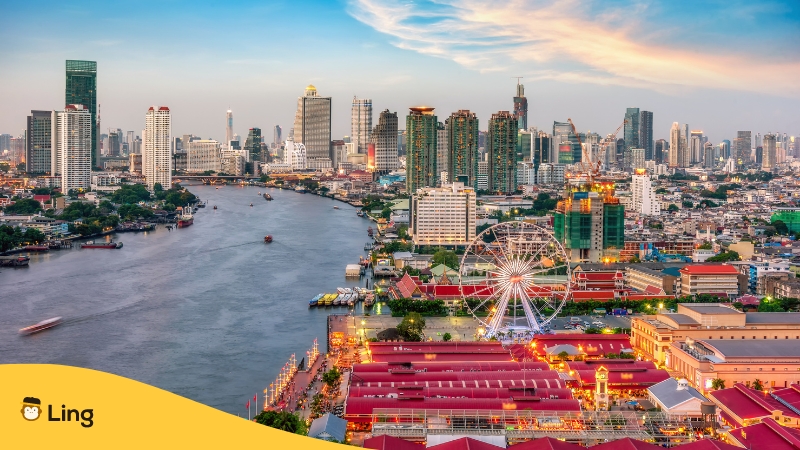
Central Region: The Standard Thai Heartland
Standard Thai dominates the central plains, including provinces like Bangkok, Ayutthaya, Lopburi, Nonthaburi, Pathum Thani, and Chonburi (home to Pattaya). This region represents Thailand’s economic and political center, where the dialect evolved from the Sukhothai and Ayutthaya kingdoms. Nearly 100% of residents in provinces like Ang Thong and Chai Nat speak Standard Thai as their primary language.
Northern Region: Lanna Territory
Northern Thai spreads across seventeen provinces in the upper part of the country. Major Kam Mueang-speaking areas include Chiang Mai, Chiang Rai, Lamphun, Lampang, Mae Hong Son, Nan, Phayao, and Phrae. In Mae Hong Son, hill tribe languages actually form the majority at 63% of the provincial population, making it Thailand’s most linguistically diverse province.
Northeastern Region: The Isan Plateau
The expansive Isan region covers twenty provinces, including Nakhon Ratchasima (Khorat), Khon Kaen, Udon Thani, Ubon Ratchathani, Buriram, Surin, and Sisaket. The 2025 regional population stands at approximately 22 million people.
In the southern Isan provinces of Surin and Sisaket, substantial Khmer-speaking minorities coexist with Isan speakers—Surin is 47% Khmer-speaking while Sisaket is 26% Khmer-speaking.
Southern Region: The Pak Tai Corridor
Southern Thai is spoken from the southern part of Prachuap Khiri Khan province through Chumphon, Ranong, Surat Thani, Nakhon Si Thammarat, Krabi, Phang Nga, Phuket, and down to the deep southern provinces of Songkhla, Yala, Pattani, and Narathiwat.
The deep southern provinces of Yala, Pattani, and Narathiwat are over 60% Malay-speaking, creating a unique trilingual environment where residents speak Patani Malay, Southern Thai, and Standard Thai.
What Makes Standard Thai Different From Regional Dialects?
Standard Thai (also called Central Thai, Siamese, or Bangkok Thai) is the reference point from which all regional varieties are compared. It functions as Thailand’s linguistic bridge, allowing people from different regions to communicate effectively.
The Official Status And Reach
Standard Thai is the language of power, education, and economic mobility. According to the Mahidol University International College (MUIC) 2025 Employer Survey, 93% of employers prioritize Standard Thai communication proficiency over academic grades, viewing it as essential for workplace readiness[3]. While only 20-27 million people speak it natively, approximately 44-45 million use it as a second language, bringing total proficiency to 96% of the population.
The Five-Tone System
Standard Thai uses a five-tone system: mid, low, falling, high, and rising. These tonal distinctions are crucial for meaning. The syllable /khao/ demonstrates this perfectly:
- ข่าว (khàao) – news (falling tone)
- ข้าว (khâao) – rice (falling tone, different vowel length)
- เข้า (khâo) – to enter (falling tone)
- ขาว (khǎao) – white (rising tone)
A single mispronounced tone can completely change a word’s meaning, which is why Thai requires approximately 1,100 hours of intensive study for English speakers to reach professional proficiency, according to the Foreign Service Institute (FSI) classification[4]. This places Thai in Category III and makes it one of the most challenging Asian languages for English speakers.
Written In Thai Script
Standard Thai is written in an abugida script consisting of 44 consonants and 32 vowels, which evolved from the ancient Khmer script. All four major dialects use the same Thai alphabet, so learning to read Standard Thai gives access to written materials from any region, even though pronunciation and vocabulary differ significantly.
How Different Is Northern Thai From Standard Thai?
Northern Thai (Kam Mueang or Lanna) preserves the linguistic heritage of the independent Lanna Kingdom, which wasn’t fully integrated into the Thai state until the late 19th century. This historical autonomy explains why Northern Thai feels so distinct to Bangkok ears.
The Six-Tone System With A Twist
Northern Thai typically features six tones instead of Standard Thai’s five, including a unique high-level tone with glottal closure. One of the most recognizable sound changes is the transformation of Standard Thai’s /r/ sound to /h/ or /l/ in Northern Thai. This makes words like รัก (rák – love) sound like ฮัก (hák) in the north.
Northern Thai Vocabulary Examples
In cities like Chiang Mai, here’s how Northern Thai will differ from Standard Thai in everyday conversation:
| English | Northern Thai | Pronunciation | Standard Thai | Pronunciation |
| I | เปิ้น | bpə̂ən | ฉัน | chǎn |
| You | ตั๋ว | dtǔa | เธอ | təə |
| Speak | อู้ | ûu | พูด | pûut |
| Look | ผ่อ | pɔ̀ɔ | ดู | duu |
| Love | ฮัก | hák | รัก | rák |
| Delicious | ลำ | lam | อร่อย | à-rɔ̂ɔi |
| House | เฮือน | hʉan | บ้าน | bâan |
| Man | ป้อจาย | bpɔ̂ɔ-jaai | ผู้ชาย | pûu-chaai |
| Woman | แม่ญิง | mɛ̂ɛ-ying | ผู้หญิง | pûu-yǐng |
| Brother | อ้าย | âai | พี่ชาย | pîi-chaai |
Notice how “speak” becomes อู้ (ûu) instead of พูด (pûut)—completely different words. These aren’t just accent differences; they’re distinct vocabulary choices that reflect centuries of separate development.
Two Sub-Dialects: Upper And Lower Northern Thai
Linguists divide Northern Thai into Upper Northern (Chiang Mai, Chiang Rai, Mae Hong Son) and Lower Northern (Phitsanulok, Sukhothai). The main difference lies in negative markers: Upper Northern predominantly uses /bɔ̀/ while Lower Northern uses /mâj/, aligning more closely with Standard Thai.
What Does Northeastern Thai (Isan) Sound Like?
Isan is essentially a collection of Lao dialects that found themselves on the Thai side of the border when modern nation-states formed. As the most widely spoken regional variety with 33% of Thailand’s population, Isan represents a demographic powerhouse that shapes national culture through food, music, and media.
The Connection to Lao
Isan shares more linguistic features with Lao (the official language of neighboring Laos) than with Standard Thai. This reflects the region’s history as part of the Lan Xang Kingdom before French and Thai colonial powers divided the area. Many Isan speakers can understand Lao television and music without difficulty.
Northeastern Thai Vocabulary Examples
Here’s how Isan transforms everyday conversation:
| English | Isan Thai | Pronunciation | Standard Thai | Pronunciation |
| I | ข่อย | kɔ̀ɔi | ฉัน | chǎn |
| You | เจ้า | jâo | คุณ | kun |
| We | เฮา | hao | พวกเรา | pûak-rao |
| Speak | เว้า | wáo | พูด | pûut |
| Look | เบิ่ง | bə̀əng | ดู | duu |
| Delicious | แซ่บ | sɛ̂ɛp | อร่อย | à-rɔ̂ɔi |
| Like | มัก | mák | ชอบ | chɔ̂ɔp |
| Stupid | ปึก | bpʉ̀k | โง่ | ngôo |
| Angry | สูน | sǔun | โกรธ | gròot |
| Fun | ม่วน | mûan | สนุก | sà-núk |
The word for “delicious” is แซ่บ (sɛ̂ɛp) in Isan versus อร่อย (à-rɔ̂ɔi) in Standard Thai—you’ll hear this constantly if you visit Northeastern restaurants or try authentic Isan cuisine like som tam (papaya salad) or larb (minced meat salad).
Isan’s Cultural Renaissance
Historically stigmatized as “rural” or “uneducated,” Isan has experienced a dramatic resurgence in cultural prestige over the past two decades. Modern Thai cinema and music genres like Mor Lam and Luk Thung frequently use Isan to signify authenticity and regional pride. Isan is classified as stable on the EGIDS scale[2], indicating its vitality remains high despite pressure from Standard Thai.
Why Is Southern Thai The Hardest To Understand?
Ask any Bangkok Thai speaker about Southern Thai, and they’ll tell you it sounds like a rapid-fire staccato that’s nearly impossible to follow. Southern Thai features a seven-tone system—the most complex of all Thai dialects[5]—and native speakers talk significantly faster than their central counterparts.
The Seven Tones And Lightning Speed
While Standard Thai uses five tones and Northern and Northeastern Thai use six, Southern Thai employs seven distinct tonal patterns. Combined with notably rapid speech, this creates a formidable listening challenge even for native Thai speakers from other regions.
Linguistic research has identified nine distinct sub-dialects within Southern Thai based on tonal patterns[5], reflecting the region’s geographic spread along the narrow Malay Peninsula. These range from Upper Eastern (Bang Saphan and Chumphon areas) to Lower Eastern (Narathiwat and Eastern Pattani).

Southern Thai Vocabulary Examples
Southern Thai vocabulary shows strong Malay influence from centuries of trade and cultural exchange:
| English | Southern Thai | Pronunciation | Standard Thai | Pronunciation |
| Speak | แหลง | lɛ̌ɛng | พูด | pûut |
| Delicious | หรอย | rɔ̌ɔi | อร่อย | à-rɔ̂ɔi |
| House | เริน | rəən | บ้าน | bâan |
| Angry | หวิบ | wìp | โกรธ | gròot |
| We | โบ๋เรา | bǒo-rao | พวกเรา | pûak-rao |
| They | โบ๋สู | bǒo-sǔu | พวกเขา | pûak-kǎo |
| Never | ไม่หอน | mâi-hɔ̌ɔn | ไม่เคย | mâi-kəəi |
| How are you? | พันพรือ | pan-prʉʉ | เป็นอย่างไร | bpen-yâang-rai |
Notice “speak” becomes แหลง (lɛ̌ɛng)—completely unrecognizable from พูด (pûut), อู้ (ûu), or เว้า (wáo). These aren’t pronunciation variations; they’re entirely different words.
The Malay Peninsula Influence
The deep south’s proximity to Malaysia has created a unique trilingual environment. Approximately 1.5 million native Patani Malay speakers use Southern Thai as a second language for regional commerce and government interaction. In provinces like Yala and Pattani, over 60% of residents speak Malay as their primary language, making Standard Thai effectively a third language for many locals.
Can Thai People Understand All Dialects?
The short answer: not without prior exposure. While most Thais can speak Thai in its standard form due to mandatory education, understanding regional dialects requires familiarity and practice.
The Reality Of Mutual Intelligibility
Without prior exposure, speakers of different regional varieties often struggle to understand each other. A Bangkok native might catch less than half of what a Chiang Mai grandmother says in pure Kam Mueang, or what a Khon Kaen vendor says in rapid Isan.
However, most Thais grow up in a state of diglossia, using their regional dialect at home and with family while speaking Standard Thai in formal settings, schools, and media. This creates widespread passive understanding where younger generations can comprehend their grandparents’ regional speech but respond in Standard Thai.
Regional Pride Vs. Economic Pressure
The 2026 labor market creates powerful incentives for linguistic assimilation. According to MUIC’s employer survey, 90% of employers now require AI literacy and 93% demand English proficiency alongside Standard Thai[3], making “Standard Thai plus English” bilingualism the new gold standard for career success.
This economic reality forces internal migrants from the Northeast and North to suppress regional accents and dialects to gain social and professional mobility in cities like Bangkok, Phuket, and major industrial centers. Yet regional varieties persist in homes, markets, and local media as badges of cultural identity—you’ll hear plenty of Thai slang and regional expressions that reflect local pride.
How Are Thai Dialects Changing In 2026?
Thailand’s linguistic landscape is at a critical crossroads. While regional dialects remain vibrant in rural areas and among older generations, multiple forces are reshaping how and where these varieties are spoken.
The Demographic Time Bomb
Thailand became a “complete-aged society” in 2025, with 21.2% of the population aged 60 and over, according to the National Statistical Office’s 2025 Population and Housing Census[1]. This aging trend has profound implications for dialect preservation because elderly residents are often the last generation of “pure” dialect speakers.
With Thailand’s total fertility rate plummeting to just 0.87-1.1 children per woman—one of the lowest in Southeast Asia[6]—fewer children are learning regional dialects as their primary tongue. The average household size has shrunk to just 2.5 persons, down from 6 persons forty-five years ago[1]. These smaller families, combined with urban migration, disrupt the intergenerational transmission of regional speech.
By 2030, Thailand is projected to become a “super-aged society” with 25.2% of residents over 60. Linguists warn that within two decades, the most distinct phonological features of regional dialects may vanish as the older generation passes away, leaving behind a more homogenized “Neo-Standard Thai.”
Digital Preservation Efforts
The year 2025 marked a turning point for dialect preservation through technology. As part of the United Nations’ “International Decade of Indigenous Languages,” Thailand launched digital humanities initiatives to document and safeguard regional varieties.
Researchers at Mahidol University are using AI and deep learning models to improve Natural Language Processing (NLP) for Thai dialects. Because Northern, Isan, and Southern Thai have different tonal inventories than Standard Thai, typical Automatic Speech Recognition (ASR) systems often fail to accurately transcribe regional speech[7].
New research focuses on “low-resource” language modeling to build speech corpora that preserve authentic dialect pronunciation.
Moreover, the 2025 “Digital Census” by the NSO provides unprecedented data on linguistic distribution by actual residence rather than registration, giving policymakers better tools to understand where dialects remain vigorous and where they’re at risk.
The Urban Language Shift
With 53.5% of Thailand’s population now urban[8], cities act as linguistic melting pots where Standard Thai dominates. The economic pull of Bangkok and regional urban centers encourages migrants to adopt the prestige dialect for social mobility—a reality many expats experience when living in Thailand.
Yet paradoxically, urban areas also fuel dialect preservation through cultural pride movements. Isan restaurants in Bangkok celebrate Northeastern identity through food, music, and language. Northern Thai cafes in Chiang Mai attract young people eager to connect with Lanna heritage. Southern Thai media producers create content that showcases Pak Tai’s unique sound and humor.
Learning Thai Dialects With Ling
Understanding Thai dialects opens doors to deeper cultural connections and authentic travel experiences. Whether you’re planning to study in Bangkok, retire in Chiang Mai, work in Khon Kaen, or vacation in Phuket, knowing regional variations helps you navigate Thailand’s diverse regions with confidence.
Ling teaches 70+ languages with a focus on underserved Asian and Eastern European languages, including a comprehensive course in Standard Thai. The app’s interactive approach uses native-speaker audio to help learners hear authentic pronunciation from real Thai speakers.
Gamified lessons on Ling take 10-15 minutes per session, making it easy to build practical Thai language skills. The app’s streak feature and soft gamification keep you motivated while learning vocabulary, tones, and the Thai script.
Start your Thai learning journey by mastering Standard Thai fundamentals, then explore regional varieties as you gain confidence. Download the Ling app from Google Play or the Apple App Store to access:
- Standard Thai native-speaker audio
- Vocabulary organized by real-life situations and topics
- Speech recognition to master Thai’s challenging tonal system
- Cultural notes with information on different Thai dialects and more Thai culture facts
- Bite-sized lessons that fit any schedule
Thai learners choose Ling to succeed because it makes language learning playful, practical, and deeply connected to real-world usage. Join them today!
Frequently Asked Questions About Thai Dialects
How Many Thai Dialects Are There?
Thailand has four major dialects: Standard Thai (Central), Northern Thai (Kam Mueang), Northeastern Thai (Isan), and Southern Thai (Pak Tai). However, the country is home to 51 living indigenous languages according to Ethnologue, including numerous hill tribe languages, Khmer varieties, and Malay dialects that coexist with the four primary Thai varieties.
What Are The Top 5 Languages Spoken In Thailand?
The top languages by speaker population are: (1) Standard Thai with 96% proficiency across the population, (2) Isan/Northeastern Thai with 15-23 million native speakers, (3) Northern Thai with 6 million speakers, (4) Southern Thai with 4.5-6 million speakers, and (5) Northern Khmer with approximately 1.4 million speakers in provinces like Surin and Sisaket.
Can I Learn Thai In One Region And Use It Everywhere?
Yes, if you learn Standard Thai (Central Thai). This official variety is taught in all schools and used in media, government, and business nationwide. Nearly 96% of Thais speak it fluently as either a first or second language. While locals will speak regional dialects at home, they can easily switch to Standard Thai when talking with outsiders.
Which Thai Dialect Is Easiest For Foreigners To Learn?
Standard Thai is easiest because it has the most learning resources, including textbooks, apps like Ling, and language schools throughout Thailand. It uses a five-tone system compared to six or seven tones in regional dialects. Plus, you’ll find more native speakers willing to practice with you in Bangkok and other major cities where Standard Thai dominates.
Is Isan A Dialect Or A Separate Language?
Linguistically, Isan is more closely related to Lao than to Standard Thai, with limited mutual intelligibility with Central Thai. This suggests it could be classified as a separate language. However, politically and administratively, Thailand treats it as a dialect. Most speakers are fully bilingual in Isan and Standard Thai due to Thailand’s education system.
Why Does Southern Thai Sound So Different?
Southern Thai features seven tones compared to Standard Thai’s five, and native speakers talk notably faster. The dialect also incorporates many Malay loanwords from centuries of trade along the Malay Peninsula. These factors combine to make it the most phonologically distinct and challenging Thai variety for outsiders to understand, even other native Thai speakers.
Will Thai Dialects Disappear?
Regional dialects face pressure from urbanization, digital media, and economic forces favoring Standard Thai. Thailand’s aging population (21.2% over age 60 in 2025) and ultra-low birth rate mean fewer children learn dialects as their first language. However, digital preservation efforts, cultural pride movements, and the sheer number of speakers—especially the 20+ million Isan speakers—suggest these varieties will survive in modified form for decades to come.
How Do I Know Which Thai Dialect Someone Is Speaking?
Listen for the word “speak” itself: พูด (pûut) indicates Standard Thai, อู้ (ûu) signals Northern Thai, เว้า (wáao) is Isan, and แหลง (lɛ̌ɛng) reveals Southern Thai. Also notice speed—Southern Thai is notably faster—and regional vocabulary for common words like “delicious”: อร่อย (à-rɔ̂ɔi) in Standard Thai, ลำ (lam) in Northern, แซ่บ (sɛ̂ɛp) in Isan, and หรอย (rɔ̌ɔi) in Southern.
Thai Dialects: Unity In Diversity
Thailand’s four major dialects—Standard Thai, Northern Thai (Kam Mueang), Northeastern Thai (Isan), and Southern Thai (Pak Tai)—represent far more than linguistic variations. They embody centuries of cultural heritage, regional identity, and the lived experiences of over 70 million people navigating tradition and modernity.
While Standard Thai connects the nation through education, media, and commerce, regional dialects remain the heartbeat of local communities—heard in family kitchens, neighborhood markets, and cultural celebrations. The dramatic differences in vocabulary (พูด versus อู้ versus เว้า versus แหลง for “speak”) remind us that Thailand’s unity exists not through uniformity, but through respect for diversity.
As Thailand faces demographic transitions and digital transformation in 2026, the future of these dialects hinges on intentional preservation efforts, cultural pride movements, and technology that honors linguistic diversity. Whether you’re learning about Thai culture, understanding Thai people, or planning to immerse yourself in the language, recognizing these regional varieties enriches your connection.
Thai dialects are invitations to deeper understanding, not obstacles to communication. Every time you recognize an Isan word in Bangkok, attempt Northern Thai pronunciation in Chiang Mai, or appreciate Southern Thai’s lightning-fast rhythm in Phuket, you’re participating in Thailand’s living linguistic heritage.
Ready to explore Thailand’s linguistic diversity yourself? Get Ling and start learning Thai today!
Sources
- [1] National Statistical Office of Thailand. “Preliminary Results of the 2025 Population and Housing Census.” The Nation Thailand, April 2025.
- [2] Ethnologue: Languages of the World. “Thailand Languages, Literacy, & Maps.” 25th Edition, 2025.
- [3] Mahidol University International College. “AI Skills & English Top 2025 Job Market Demand: MUIC Report.” The Nation Thailand, December 2025.
- [4] United States Department of State. “Foreign Language Training.” 2017-2021.
- [5] eVols, University of Hawaii at Manoa. “Tonal Geography of the Southern Thai Dialects.”
- [6] Chiang Rai Times. “Thailand Launches Urgent ‘Every Birth Matters’ Plan As Births Hit A 75-Year Low.” February 2025.
- [7] MDPI. “The Development of Northern Thai Dialect Speech Recognition Using Deep Learning.” Applied Sciences 13, no. 4 (2023): 2270.
- [8] Statistics Times. “Demographics of Thailand.” 2025.