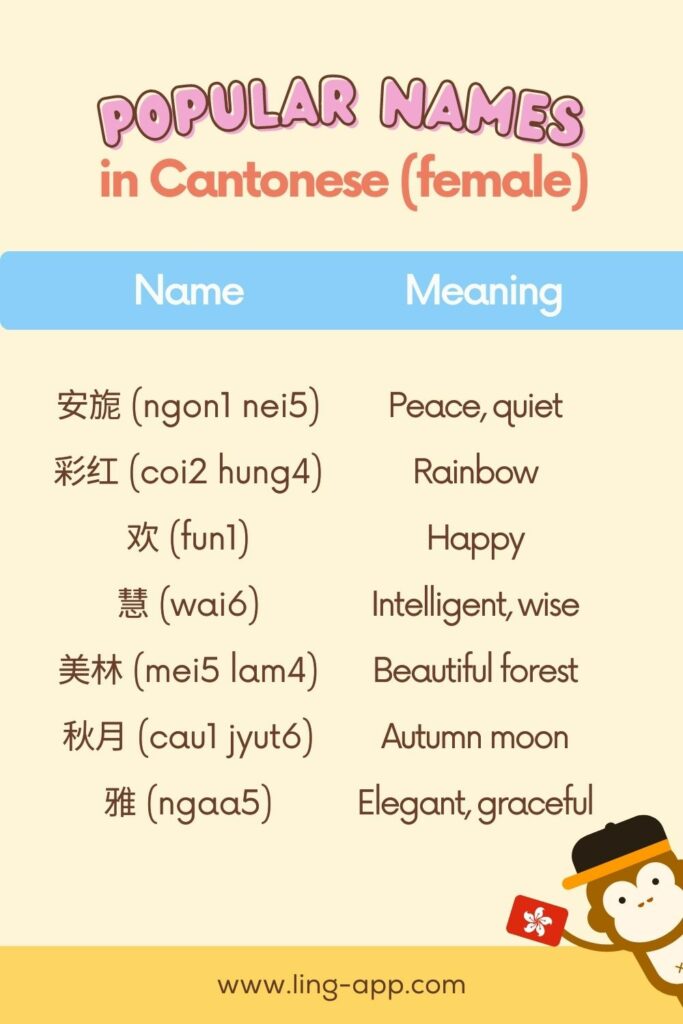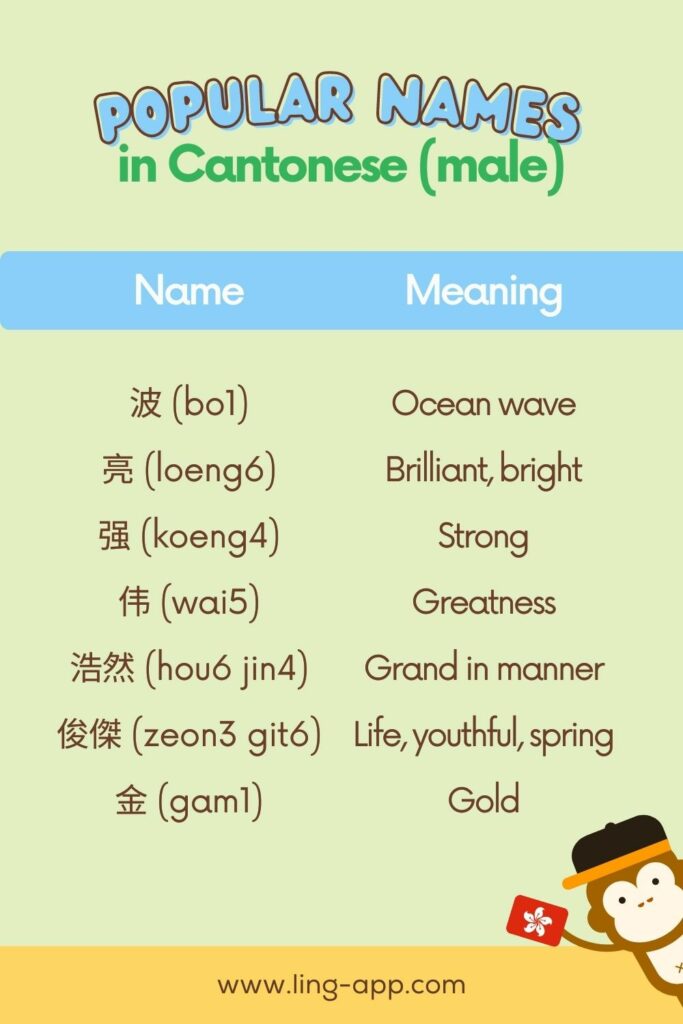


Interested in learning Cantonese names with Ling?
Let’s explore 100 common Cantonese names, along with their pronunciations and meanings, like Huang (凰), which means ‘phoenix,’ and Jin (金), which means ‘gold.’ We’ll also go over some common facts and trivia about names, discover common surnames, and even learn how to address a Hong Konger.
If you are interested in learning Cantonese, keep reading below!

Common Facts And Trivia About Cantonese Names
- Hong Kong names are based on Chinese naming customs.
- In the Cantonese alphabet and writing, Hong Kongers employ Chinese characters to write English names.
- Structure: Family Name + First Name + Second Name (3 Elements) or Family Name + Given Name (2 Elements)
- The given name is selected at birth as the individual’s identification. One or two syllables/Chinese characters are possible. Two-syllable/Chinese character names can be written in Cantonese combined, hyphenated, or separated into two. However, in Hong Kong, it is customary to write one’s given name as two separate words.
- Family names and given names are written without spaces.
- Many Chinese characters can be used as both personal and family names.
- The family name is inherited from the person’s parents and shared with other immediate family members and relatives. It appears before the given name or first name.
- Elements: Every element of a Chinese name has meaning. Given names frequently have a literal meaning that indicates a desirable value, attribute, or characteristic for the individual. Parents usually give their children names that symbolize their expectations. They do not give names with negative meanings. They even consult a fortune teller.
- Do you love your pets? Why not check this extensive list of animal names in Cantonese?
- Names have different aspirational implications for men and women. But, when it was being translated to the Roman alphabet, telling the gender using the name appeared to be tricky.
- There are two ways to come up with your Cantonese name. The first one is using the meaning of your name, which is the traditional one. The second one is by taking out the sound of Chinese characters and creating a Cantonese name comparable to your English name. Example: Daniel (Da, Ni, El): 丹 (daan1) 尼 (nei4) 爾 (ji5) = 丹尼爾 (daan1 nei4 yi5)
- It is neither common nor appropriate to name a child after a parent or other relative.
- In some families, immediate siblings may have the same character in their names, referred to as a “generation” name.
- Cantonese speakers use their own Pinyin system, which differs from mainland Chinese Mandarin spellings.
- Because there are so many ways to express Chinese characters in English, the same Chinese name can be spelled with various spellings depending on the dialect and transcription system employed.
- Women do not change their legal names during marriage. However, some government employees may prefer to use their husband’s surname before their own.
- Close friends and family may address one another according to their social standing or kinship.
- There are also specific names for colors in Cantonese, which have their own specific symbolism and meaning.
Pronunciation Of Common Cantonese Names
- Jyutping: Jyutping’s digits are tone marks that can be erased to make reading easier.
- You need to learn how to pronounce the names right. Cantonese used to be known and defined as just a spoken language. It uses the same standard Chinese characters, but Cantonese has a lot of differences, especially in pronunciation. Cantonese is pronounced differently. It also has nine (9) tones than the regular Chinese languages.
Westernizing Cantonese Names
- Many people use a ‘westernized’ version of their original Chinese name to adapt to international and English-speaking situations. This will involve changing the order or the arrangement of the name.
Format: English name + Cantonese Family Name + Cantonese given name. - The majority of Hong Kong residents have an English name that they use daily and in foreign and English-speaking situations, which can be chosen by their immediate Cantonese family members or themselves.
- English Names Using Chinese Characters
| English Name | Cantonese | Pronunciation |
|---|---|---|
| Daniel | 丹尼爾 | daan1 nei4 ji5 |
| George | 佐治 | zo2 zi6 |
| Jacob | 雅各 | nga5 gok3 |
| Jennifer | 珍妮花 | zan1 nei4 faa1 |
| Kimberly | 金佰利 | gam1 baak3 lei6 |
| Michael | 米高 | mai5 gou1 |
| Noah | 諾亞 | nok6 aa3 |
| Thomas | 湯瑪斯 | tong1 maa5 si1 |
What Are Common Cantonese/Chinese Names?
Now that you already know common Cantonese last names, let us learn some personal names in Cantonese (名 meng2). Some of them even show their love for their country. If you’re interested in learning the names of countries in Cantonese, we also have an article just for you.
Male Names in Cantonese
| Meaning | Name | Cantonese And Pronunciation |
|---|---|---|
| Love of country | Aiguo | 愛國 (ngoi3 gwok3) |
| white, pure, many, cypress tree | Bai | 擺 (baai2) |
| Ocean wave | Bo | 波 (bo1) |
Abundant, literate, rich | Bowen | 博文 (bok3 man4) |
| long, prosper, good, smooth, sunlight | Chang | 張 (zoeng1) |
| tide, surpass | Chao | 趙 (ziu6) |
| morning | Chen | 陳 (can4) |
| sincere, finished | Cheng | 鄭 (zeng6) |
Accomplishing goals in life | Chih-Cheng | 志成 (zi3 sing4) |
| Having great objectives in life | Chia-Hao | 家豪 (gaa1 hou4) |
| Having clear goals in life | Chih-Ming | 志明 (zi3 ming4) |
| life, youthful, spring | Chun-Chieh | 俊傑 (zeon3 git6) |
| intelligence, great, attaintment | Da | 达 (daat6) 大 (daai6) |
| virtue | De | 德 (dak1) |
| pillar, East | Dong | 东 (dung1) 栋 (dung6) |
| summit | Feng | 峯 (fung1) |
| virtuous, fragrant | Fang | 芳 (fong1) 方 (fong1) |
| hibiscus, wealthy, father, man | Fu | 富 (fu3) 芙 (fu4) 甫 (pou2) |
| strong | Gang | 剛 (gong1) |
| country | Guo | 国 (gwok3) |
| sea | Hai | 海 (hoi2) |
| grand in manner | Haoran | 浩然 (hou6 jin4) |
| a grand house | Hao-Yu | 浩宇 (hou6 jyu5) |
| river or harmony | He | 河 (ho4) 和 (wo4) |
| constant | Heng | 恒 (hang4) |
| rainbow, expand, vast, wild swan | Hong | 虹 (hung4) 红 (hung4) 弘 (wang4) 鸿 (hung4) 宏 (wang4) |
| home, auspicious, family | Jia | 佳 (gaai1) 家 (gaa1) |
| establish, build, strong, healthy | Jian | 建 (gin3) 健 (gin6) |
| gold | Jin | 金 (gam1) |
| capital city, quiet, crystal, spirit | Jing | 静 (zing6) 精 (zing1) 晶 (zing1) 京 (ging1) |
| start, victory | Kai | 凯 (hoi2) 开 (hoi1) 開 (hoi1) 啟 (kai2) |
| forest | Lin | 林 (lam4) |
| brilliant, bright | Liang | 亮 (loeng6) |
| bright | Ming | 明 (ming4) |
| stable, level | Ping | 平 (ping4) |
| strong | Qiang | 强 (koeng4) |
| hill, autumn | Qiu | 秋 (cau1) 丘 (jau1) |
| glory, prosperous, appearance, and harmonize | Rong | 荣 (wing4) 融 (jung4) 容 (jung4) |
| generation, stone, honest, history | Shi | 时 (si4) 实 (sat6) 史 (si2) 石 (sek6) |
| large waves | Tao | 涛 (tou4) |
| greatness | Wei | 伟 (wai5) |
| a literate | Wen | 文 (man4) |
| military | Wu | 武 (mou5) |
| soar good luck | Xiang | 翔 (coeng4) 祥 (coeng4) |
| ocean, male, sunny | Yang | 洋 (joeng4) 阳 (joeng4) |
| Rain or friend, pool or brilliance | Ying | 雨泽 (jyu5 zaak6) |
| high house | Yuxuan | 宇轩 (jyu5 hin1) |
| tolerate, child | Zihan | 子涵 (zi2 haam4) |
| child, high | Zixuan | 子轩 (zi2 hin1) |
Female Names In Cantonese
| Meaning | Name | Cantonese And Pronunciation |
|---|---|---|
| love, affection, or friendly, lush | Ai | 爱 (ngoi3) 蔼 (oi2) |
| quiet, peace | An | 安 (ngon1) |
| peace, quiet, elegant, delicate, graceful | An Na | 安納 (ngon1 naap6) |
| peace, quiet | An Ni | 安旎 (ngon1 nei5) |
| bud, treasure | Bao | 宝 (bou2) 苞 (baau1) |
| green jade | Bi | 碧 (bik1) |
| rainbow | Caihong | 彩红 (coi2 hung4) |
| Spring season | Chun | 春 (ceon1) |
| fragrance, perfume | Fen | 芬 (fan1) 芳 (fong1) |
| prosperous, flourishing, coming from the seas | Hai Rong | 海榮 (hoi2 wing4) |
| happy | Hua | 欢 (fun1) |
| phoenix | Huang | 凰 (wong4) |
| intelligent, wise | Hui | 慧 (wai6) |
| quiet, harmony, gentle, joy | Jìngyi | 靜義 (zing6 ji6) 静怡 (zing6 ji4) |
| chrysanthemum | Ju | 菊 (guk1) |
| beautiful, graceful | Juan | 娟 (gyun1) |
| earth, female | Kun | 坤 (kwan1) |
| elegant, orchid | Lan | 兰 (laan4) |
| bud | Lei | 蕾 (leoi4) |
| beautiful | Li | 丽 (lai6) |
| spirit, bell | Ling | 灵 (ling4) 铃 (ling4) |
| beautiful or plum | Mei | 美 (mei5) 梅 (mui4) |
| wise, beautiful | Mei-hui | 美惠 (mei5 wai6) |
| beautiful forest | Meilin | 美林 (mei5 lam4) |
| beautiful spirit | Meiling | 美灵 (mei5 ling4) |
| delicate, elegant | Na | 暖 (nyun5) |
| peaceful | Ning | 宁 (ning4) |
| genial and warm | Nuan | 娜 (naa4) |
green, blue, young | Qing | 青 (cing1) 清 (cing1) |
| autumn moon | Qiuyue | 秋月 (cau1 jyut6) |
| good, virtuous | Shu | 淑 (suk6) |
| good fragrance | Shufen | 淑芬 (suk6 fan1) |
| submit, obey | Shu-hui | 淑惠 (suk6 wai6) |
| simple, plain, respectful | Su | 素 (sou3) 肃 (suk1) |
| Feminine forms mean petite or fern | Wei | 微 (mei4) 薇 (mei4) |
| elegant, beautiful, luxurious | Xiu | 秀 (sau3) |
| beautiful orchid | Xiulan | 秀兰 (sau3 laan4) |
| petal, beautiful flower | Xiuying | 秀英 (sau3 jing1) |
| snow or learning | Xue | 雪 (syut3) 学 (hok6) |
| elegant, graceful | Ya | 雅 (ngaa5) |
| beautiful | Yan | 艳 (jim6) |
| elegant and graceful | Ya-ting | 雅婷 (ngaa5 ting4) |
| graceful clouds | Yawen | 雅雯 (ngaa5 man4) |
| Feminine versions mean joy or ceremony | Yi | 怡 (ji4) 仪 (ji4) |
| shelter, sound, silver | Yin | 银 (ngan4) 音(jam1) 荫 (jam3) |
| pleasant, jade, rain | Yu | 玉 (juk6) 愉 (jyu4) 雨 (jyu5) |
| cloud, allow | Yun | 云 (wan4) 允 (wan5) |
| real, virtuous, precious | Zhen | 珍 (zan1) 真 (zan1) 贞 (zing1) |
What are Common Chinese Surnames?
Since Cantonese/Chinese family names (姓 sing3) are written before the first name, let us also learn about Cantonese surnames or family names. As said above, Cantonese surnames are inherited from parents and shared with other family members. It is commonly a single word or Chinese character. There are, however, two-syllable last names.
As of today, the most common surname in Hong Kong is Chan (陳 Can4), followed by Leung (梁Loeng4), Cheung (張 Zoeng1), Lau (劉 Lau4), and Li (李 Lei5). Make sure that you know your Cantonese accent because the numbers in Jyutping have meanings!
If you’re familiar with the tones, below is the list of common surnames in Cantonese.
| Meaning | Surname | Cantonese | Pronunciation |
|---|---|---|---|
| white | Pak | 白 | Baak6 |
| old, Chen state | Chan | 陳 | Can4 |
| towering | Chui | 崔 | Ceoi1 |
| slow, Xu state | Tsui | 徐 | Ceoi4 |
| Qin dynasty | Chun | 秦 | Ceon4 |
| money | Chin | 錢 | Cin4 |
| rule, order, journey | Ching | 程 | Cing4 |
| Cai state | Choi | 蔡 | Coi3 |
| Cao state | Tso | 曹 | Cou4 |
| to support, to wear | Dai | 戴 | Daai3 |
| Deng state | Dang | 鄧 | Dang6 |
| a strong man | Ding | 丁 | Ding1 |
to supervise, mentor | Dung | 董 | Dung2 |
| section, part | Duen | 段 | Dyun6 |
| example | Fan | 范 | Faan6 |
| square | Fong | 方 | Fong1 |
| teacher | Fu | 傅 | Fu6 |
| Feng state, to gallop | Fung | 馮 | Fung4 |
| Merchant | Ga | 賈 | Gaa2 |
| gold | Gam | 金 | Gam1 |
| Ginger | Geung | 姜 | Goeng1 |
| river | Gong | 江 | Gong1 |
| tall | Go | 高 | Gou1 |
| to regard, to look back | Gu | 顧 | Gu3 |
| to give, to present | Gung | 龔 | Gung1 |
| summer | Ha | 夏 | Haa6 |
| to allow; Xu state | Hui | 許 | Heoi2 |
| Direction | Heung | 向 | Heung3 |
| Han state | Ho | 何 | Ho4 |
| healthy | Hong | 康 | Hong1 |
| hole, opening | Hung | 孔 | Hung2 |
| to appoint | Yam | 任 | Jam6 |
| hills | Yau | 邱 | Jau1 |
| to exchange, easy | Yik | 易 | Yik6 |
| village gate | Yim | 閻 | Jim4 |
| leaf | Yip | 葉 | Jip6 |
| aspen tree, Yang state | Yeung | 楊 | Joeng4 |
| in, on, at, to go to | Yue | 于 | Jyu1 |
| long robe | Yeun | 袁 | Jyun4 |
| tall | Kiu | 喬 | Kiu4 |
| to rely on | Lai / Lay | 賴 | Laai6 |
| a multitude | Lai | 黎 | Lai4 |
| forest | Lam | 林 | Lam4 |
| Han royalty, to kill | Lao | 劉 | Lau4 |
| Plum | Lee/Li | 李 | Lei5 |
| Thunder | Lui | 李 | Leoi4 |
| Liao state | Liu | 廖 | Liu6 |
| gatherer | Lo | 羅 | Lo4 |
| beam, Liang state | Leung | 梁 | Loeng4 |
| cottage | Lo | 羅 | Lou4 |
| land | Luk | 盧 | Luk6 |
| Dragon | Lung | 龍 | Lung4 |
| horse, Mafu state | Ma | 萬 | Maa5 |
| ten thousand | Man | 萬 | Maan6 |
| words, to write | Man | 文 | Man4 |
| not | Mok | 莫 | Mok6 |
| hair, fur | Mo | 毛 | Mou4 |
| loud, Wu state | Ng | 吳 | Ng4 |
| Wei state | Ngai | 魏 | Ngai6 |
| descendant of Peng Zu | Pang | 彭 | Pang4 |
| Pun river | Poon | 潘 | Pun1 |
| to sink | Sam | 沈 | Sam2 |
| stone | Sek | 石 | Sek6 |
| history | Si | 石 | Si2 |
| wormwood | Sit | 薛 | Sit3 |
| common, often | Seung | 常 | Soeng4 |
| to come to | So | 蘇 | Sou1 |
| Song state | Sung | 宋 | Sung3 |
| grandson | Seun | 孫 | Syun1 |
| Tang dynasty | Tong | 唐 | Tong4 |
| pleased | To | 陶 | Tou4 |
| to administer | Wan | 尹 | Wan5 |
| sea | Wong | 汪 | Wong1 |
| mustache, beard | Wu | 胡 | Wu4 |
| grandparent/child relationship, Zeng state | Tsang | 曾 | Zang1 |
| surrounding, circumference, Zhou state | Chow | 周 | Zau1 |
thankful, Xie state | Tse | 謝 | Ze6 |
| Zheng state | Cheng | 鄭 | Zeng6 |
| Zhao state | Chiu | 趙 | Ziu6 |
| to expand, to pull a string | Cheung | 張 | Zoeng1 |
| wild rice | Tseung | 蔣 | Zoeng2 |
bell, Zhongli state | Chung | 鍾 | Zung1 |
crimson, Zhu state | Chu | 朱 | Zyu1 |
How To Address A Hong Konger?
Hong Kongers are the people living in Hong Kong. When you visit Hong Kong, it’s essential to keep yourself informed of the way you address them. It’s not enough that you simply know their names. Here are some things to remember about addressing people in Hong Kong:
- Hong Kongers use several names that they use interchangeably depending on the situation. They have married names, social names, business names with corresponding Cantonese business vocabulary, school names, and English names. But do not worry too much because they usually tell you which name to use.
- Remember that the first name is an intimate form of addressing a Hong Konger. It is for family members, couples, and in-laws. If you’re just normal friends or acquaintances, it’s better to address them by their family names because it can be seen as a sign of disrespect.
- If you are a foreigner, you don’t have to worry because most Hong Kongers will introduce themselves using their English name.
- Close friends can give each other nicknames by repeating the second half of a person’s given name twice.
How Do You Say Common Names In Cantonese?
The Cantonese word for common Cantonese names is
- Chia-Hao 家豪 (gaa1 hou4)
- Chih-Ming 志明 (zi3 ming4)
- Chun-Chieh 俊傑 (zeon3 git6)
- Meilin 美林 (mei5 lam4)
- Meiling 美灵 (mei5 ling4)
- Shufen 淑芬 (suk6 fan1)
- Sze Ting 詩婷 (si1 ting4)
More Sentences For Asking Common Names In Cantonese
| Sentence | Cantonese | Pronunciation |
|---|---|---|
| What is your name | 你叫咩名? | nei5 giu3 me1 meng2? |
| Can you tell me your name? | 可唔可以話畀我知你嘅名呀? | ho2 m4 ho2 ji5 waa6 bei2 ngo5 zi1 nei5 ge3 meng2 aa3? |
| How do you write your name? | 你嘅名點寫㗎? | nei5 ge3 meng2 dim2 se2 gaa3? |
| What’s your surname? | 你姓咩呀? | nei5 sing3 me1 aa3? |
| How should I address you? | 我應該點稱呼你呀? | ngo5 jing1 goi1 dim2 cing1 fu1 nei5 aa3? |
Frequently Asked Questions About Common Names In Cantonese
How Do You Ask Someone For Their Name In Cantonese?
In Cantonese, you can ask someone for their name by saying: 你叫咩名呀?(nei5 giu3 me1 meng2 aa3?) – “What is your name?”
How Do You Ask For Someone’s Surname In Cantonese?
To ask for someone’s surname, you can say: 你姓咩呀?(nei5 sing3 me1 aa3?) – “What is your surname?”
What Are Some Common Cantonese surnames?
Some Cantonese surnames are 陳 (can4) – Chan, 黃 (wong4) – Wong, 張 (zoeng1) – Cheung, 李 (lei5) – Lee, and 林 (lam4) – Lam.
How Do You Address Someone Politely By Their Full Name In Cantonese?
In formal or polite situations, you can address someone by their full name using their title and surname. For example, if their surname is Chan, you would say:
陳先生 (can4 sin1 saang1) – Mr. Chan
陳小姐 (can4 siu2 ze2) – Miss Chan
How Do You Ask For The Meaning Of Someone’s Name In Cantonese?
You can ask about the meaning of someone’s name by saying: 你嘅名有咩意思呀?(nei5 ge3 meng2 jau5 me1 ji3 si1 aa3?) – “What does your name mean?”
Wrapping Up
Did you enjoy this list of names in Cantonese? If you’re hungry for more vocabulary, grow it more with our list of plant names in Cantonese. Planning to go to Hong Kong for work opportunities instead? Even people who want to look for a job in Hong Kong must know the job titles, right? So, when looking for work, don’t forget to memorize the different job titles in Cantonese.
Want To Learn More Cantonese Names? Use Ling!
You have learned above that the name Ling means ‘spirit’ in Cantonese. But did you know that there’s another Ling that can help you learn Cantonese more than just a common Cantonese name?
The Ling app is a language learning platform that helps develop language skills. Its well-developed features provide an engaging yet essential language-learning experience. The Ling app will also give you more information about the culture of the languages you are learning through blog posts like this.
Interacting with Hong Kongers doesn’t begin and end with self-introduction in Cantonese. After learning common Cantonese names, you can widen your vocabulary and develop your language skills using the Ling app. So, download the Ling app now!