

If you’re wondering whether or not Korea celebrates Thanksgiving, you have to find out more about the meaning of Chuseok. According to the locals, it’s one of the biggest holidays in South Korea, and is the people’s way to gather and celebrate a plentiful harvest.
Let’s find out more about the celebration and traditional holiday known as Korean Thanksgiving Day. This may even inspire you to learn Korean faster so you can book a flight in time for the next Chuseok!
The Meaning Of Chuseok
Chuseok (추석), also called Hangawi (한가위), is more than a Korean Thanksgiving Day. Actually, it’s Thanksgiving, Christmas, and New Year’s all rolled into one. It’s a three-day Korean holiday that begins on the 15th day of the 8th month according to the lunar calendar (September on the Gregorian calendar).

Why Do They Celebrate Chuseok?
Locals celebrate Chuseok to pay tribute to their ancestors and express gratitude for a bountiful harvest. This festival is more than eating tasty songpyeon (rice cakes) or playing games like ssireum (traditional Korean wrestling). Koreans use this as a chance for families to gather and visit their ancestral hometowns to pay respects to the graves of their ancestors.
Family members gather on a full harvest moon and feast on freshly harvested rice and delicious food. They perform traditional Korean rituals, such as traditional folk dance and Korean circle dance. South Koreans celebrate Chuseok with gift-giving, folk games, and hoards of other festivities.
Is Chuseok The Same As Chinese New Year?
Chuseok is among the most important holidays in Korea, along with the Lunar New Year or Seollal. It’s not the same as the Chinese New Year, since it originated from Korea’s agricultural history.
Before Chuseok, locals celebrated Gabae, an ancient harvest festival during the Three Kingdoms era. It evolved into Chuseok through the years, a celebration incorporating elements of shamanism and Confucianism, which later became what it is today – a holiday closely similar to Thanksgiving.
A Look Into Chuseok Traditions
While Thanksgiving in the United States centers around the Pilgrims and Native Americans sharing a meal, Chuseok gives praise to the hard work of farmers and provides a moment to pause and appreciate the fruits of their labor. It’s a time when Koreans come together, not just as families but as a nation, to express gratitude for the harvest season.
Preparations And Rituals
Chuseok isn’t just a one-day event. Locals have a line-up of connected activities and preparations leading up to the big day. They do special rituals like Charye (ancestral rites) during the celebration.
Family gatherings also include preparing traditional Korean delicacies that symbolize the day when the harvest moon appeared. During this time, the hosts also prepare games for everyone to enjoy on the coming day.
Food And Feasting
The Chuseok holiday wouldn’t be complete without food. Aside from songpyeon, Chuseok tables are filled with bright and beautiful food. Korean families share meals during the celebration as a symbol of unity and prosperity. These foods include traditional dishes like jeon (Korean pancakes) and japchae (stir-fried noodles).
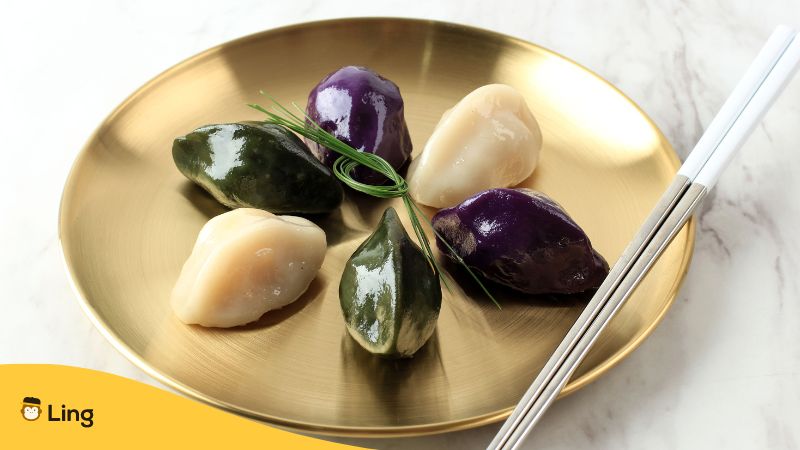
Songpyeon (송편)
If you are lucky enough to visit Korea during Chuseok, make sure that you taste this flavorful rice cake. This traditional Korean food is made from rice flour filled with sesame seeds, red bean paste, chestnuts, and secret spices. They are shaped like a half-moon and steamed with pine needles.
Families prepare them the evening before the thanksgiving celebration and believe that anyone who made perfectly-shaped rice cakes will have a happy marriage or become parents to a beautiful child.
Jeon (전)
This Chuseok favorite dinner dish is made from veggies, such as zucchini and sweet potato, mixed with mashed fish and coated with egg and flour.
Japchae (잡채)
Since we’re talking about the day for harvests, it’s a no-brainer why the locals serve Japchae! The noodles, mixed with veggies like carrot, spinach, onion, and mushrooms, are stir-fried in cooking oil and added with soy sauce and beef.
Ancestral Memorial Ceremony
Chuseok’s core revolves around the entire family honoring ancestors. They visit ancestral graves to perform Charye and Seongmyo, paying respects to those who came before them. It’s a reminder of the importance of family roots.
Unity And Family Bonds
Chuseok isn’t just about the physical act of coming together; it’s about forging deeper connections. Families gather, generation after generation, reinforcing bonds that withstand the test of time.
Korean Vocabulary For Chuseok
Here are some Korean phrases you can flex to impress your friends or family during Chuseok, or use as a conversation starter with the locals.
| English | Korean (Hangul) | Pronunciation | Audio |
|---|---|---|---|
| Chuseok | 추석 | Choo-seok | |
| Lunar Calendar | 음력 | Eum-lyeok | |
| Ancestral Rites | 차례 | Cha-rye | |
| Incense | 향 | Hyang | |
| Family | 가족 | Ga-jok | |
| Harvest | 수확 | Su-hwak | |
| Traditional Clothing | 전통 의상 | Jeon-tong ui-sang | |
| Songpyeon Making | 송편 만들기 | Song-pyeon man-deul-gi | |
| Ancestor Worship | 조상 예배 | Jo-sang ye-bae | |
| Autumn | 가을 | Ga-eul |
Chuseok Phrases In Korean
Want to impress the locals even more? Here are some common Korean phrases related to this topic.
- What are you going to do for Chuseok this year? – Olhae Chuseoge mwo hal geoeyo? (올해 추석에 뭐 할 거에요?)
- I wore a hanbok and went to see the autumn leaves with my family. – Hanbogeul ipgo gajokgwa hamkke gaeul danpungeul gugyeonghareo gasseoyo. (한복을 입고 가족과 함께 가을 단풍을 구경하러 갔어요.)
- Will you help me make songpyeon? – Songpyeon mandeuneun geo dowa jullae? (송편 만드는 거 도와 줄래?)
- This bouquet of flowers was a gift that I took to my grandmother’s. – I kkotdabal-eun halmeonnikkeso seonmullo gajyeo gass-eoyo. (이 꽃다발은 할머니께서 선물로 가져 갔어요.)
- Our family observes the ancestral rites. – Uri gajog-eun chalyeleul jik-eoyo. (우리 가족은 차례를 지켜요.)
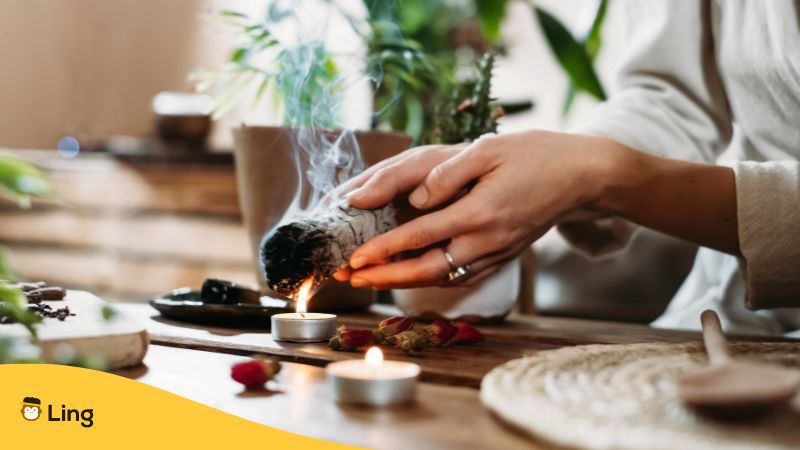
- We pay our respects to our ancestors by burning incense. – Hyang-eul pi-umyeo josangdeulkk-e gyeong-uileul pyohae-yo. (향을 피우며 조상들께 경의를 표해요. )
Frequently Asked Questions About Chuseok
When Is Chuseok 2025?
In 2025, Chuseok begins on Sunday, October 5, and ends on Tuesday, October 7.
How Long Does Chuseok Last?
In South Korea, the Chuseok festival lasts for three days, including the days before and after the full moon.
Do Koreans Give Money On Chuseok?
Yes, Koreans give money on Chuseok. Traditionally, gifts included harvest items like fruits, but cash or gift cards have become more common.
Wrapping Up
In this post, we covered the meaning of Chuseok, which is all about paying tribute to ancestors and expressing gratitude for a bountiful harvest. We learned about traditions such as Charye and Seongmyo, traditional Korean food, and the importance of unity and family bonds in Korean culture.
Now that you know more about the meaning of Chuseok, you’re all set to participate in the celebrations. You even learned some Korean vocabulary, such as ‘Family‘ – Ga-jok (가족), ‘Harvest‘ – Su-hwak (수확), and more, so go on and impress the locals!
Celebrating Chuseok? Improve Your Korean With Ling!
So, you’re all pumped up about Chuseok and want to immerse yourself fully in the vibrant Korean culture? Great! But before you pack your bags, remember that you also need to master a few Korean expressions. You see, learning Korean before your trip can go a long way, and that’s where the Ling app comes in.
On the Ling app, you’ll find short, interactive lessons, native speaker audio, finger tracing to learn the Hangul script, and even a dialog section to practice conversations. With the goal of making hard languages easy, Ling has exercises in the form of mini-games, points and streaks to keep you motivated, a couple of friendly mascots, and everything else you need on your learning journey.
So go ahead, download the Ling app on the App Store or Google Play, and start learning Korean today!