

It’s the most beautiful time of the year! Build your Christmas tree, sing carols, and get ready to explore some Korean Christmas greetings.
The Christmas season is one of the most anticipated holidays of the year. It celebrates the birth of Jesus Christ and is enjoyed by billions of people around the world on December 25, both as a religious and cultural occasion.
The cold breeze, sparkling lights, festive decorations, shopping sales, and the spirit of giving are all part of the Christmas atmosphere. But beyond the sights and sounds, the most important thing is spending time with your loved ones.

Every country has its own way of celebrating Christmas, and Korea is no exception. Here, you’ll discover some Korean words and phrases that capture the holiday spirit and help you share warm Korean Christmas greetings.
How Do You Say ‘Christmas’ In Korean?
Let us start by learning some Korean vocabulary related to Christmas. Before we learn how to say Merry Christmas in Korean, let’s first learn the following words:
Keuriseumaseu (크리스마스)
The Korean word for Christmas is Keuriseumaseu (크리스마스). It’s easy to remember because it sounds very similar to the English word. Keep in mind that this is an informal term, so it’s best used with friends or people you are familiar with.
Seongtanjeol (성탄절)
This is the formal way to say Christmas in Korean. Korean culture places a strong emphasis on politeness and hierarchy, so using the correct level of formality shows respect. Seongtanjeol (성탄절) is suitable in formal settings or when speaking with someone older or of higher status.
Seongtanjeol Jeonnya (성탄절 전야)
This term means “Christmas Eve” in Korean. On the night of December 24th, families often gather to welcome December 25th at midnight. Like in many other countries, this is a time for family meals and gift-giving, though not everyone may be able to celebrate together, especially if some family members live far away.
Merry Christmas In Korean And Other Christmas Greetings
Now that you’ve learned the essential vocabulary, let’s learn some Korean Christmas greetings.
Remember, there are different ways to say Merry Christmas in Korean. Although the sentiment is the same, it varies depending on the context and who you are speaking to. Koreans speak differently depending on whom they are addressing. That is why these Korean Christmas greetings are divided into three categories.
Standard Korean Christmas Greetings
The first category is the standard form. The standard form is the most commonly used style in spoken Korean because it is neither too formal nor too informal, so it does not sound rude. Notice the Hangul character yo (요). It’s added at the end of a sentence to make it more polite than the informal form. Here are the standard Korean Christmas greetings.
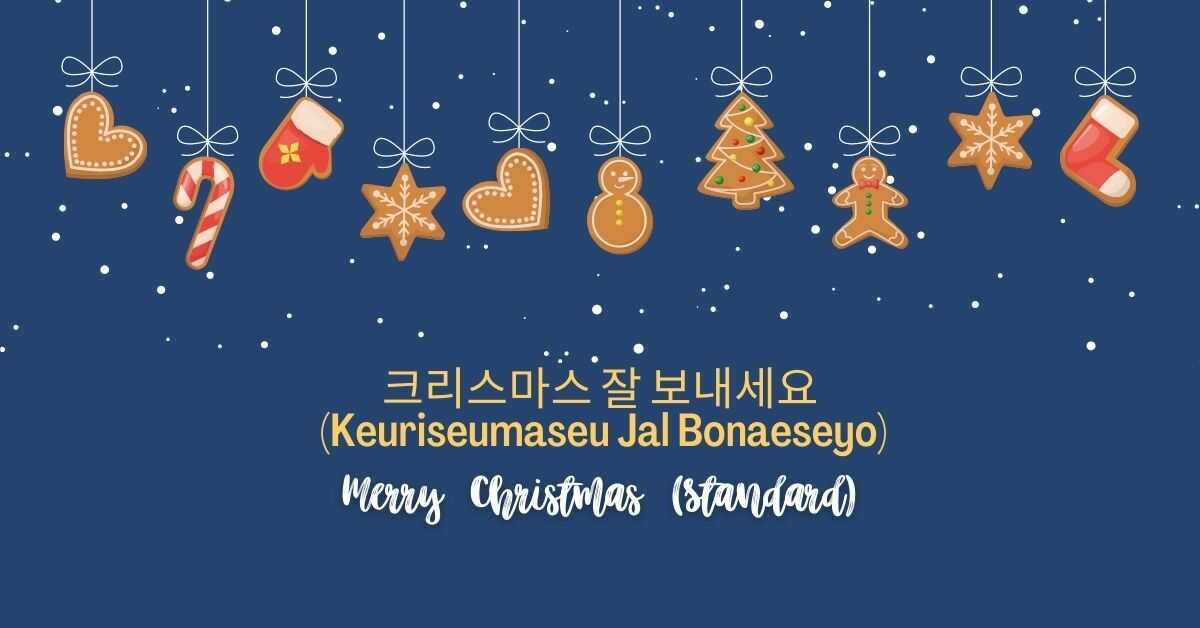
1. Merry Christmas – Keuriseumaseu Jal Bonaeseyo (크리스마스 잘 보내세요 )
The first Korean Christmas greeting we will learn is Keuriseumaseu Jal Bonaeseyo (크리스마스 잘 보내세요). This is a friendly, polite greeting you can use with anyone. Koreans don’t have an extended Christmas vacation, so the holiday is typically celebrated for just one day since it is a national holiday.
You may also hear Keuriseumaseu Jal Bonaeyo (크리스마스 잘 보내요), which has the same meaning but is slightly less polite. The Korean character se (세) is removed, making the version less formal than the first one. It is still completely acceptable to use, though the first version is generally preferred.
2. Enjoy The Holidays – Hyuil Jal Jeulgiseyo (휴일 잘 즐기세요!)
The next Korean Christmas greeting we will learn is Hyuil Jal Jeulgiseyo! (휴일 잘 즐기세요!). If you want an alternative that doesn’t mention “Christmas,” this one is perfect.
3. Happy Holidays – Haengbokan Hyuil Bonaeseyo (행복한 휴일 보내세요!)
Saying “Happy Holidays,” Haengbokan Hyuil Bonaeseyo! (행복한 휴일 보내세요!), is another Korean Christmas greeting you can use without mentioning the word “Christmas.” It is also useful when greeting someone who does not celebrate Christmas because of their religion or beliefs.
Formal Korean Christmas Greetings
The formal form of spoken Korean is used when talking to people higher in social hierarchy than you. This includes the elderly, your boss, and anyone older than you. Here are two ways to say Merry Christmas in Korean using the formal form.
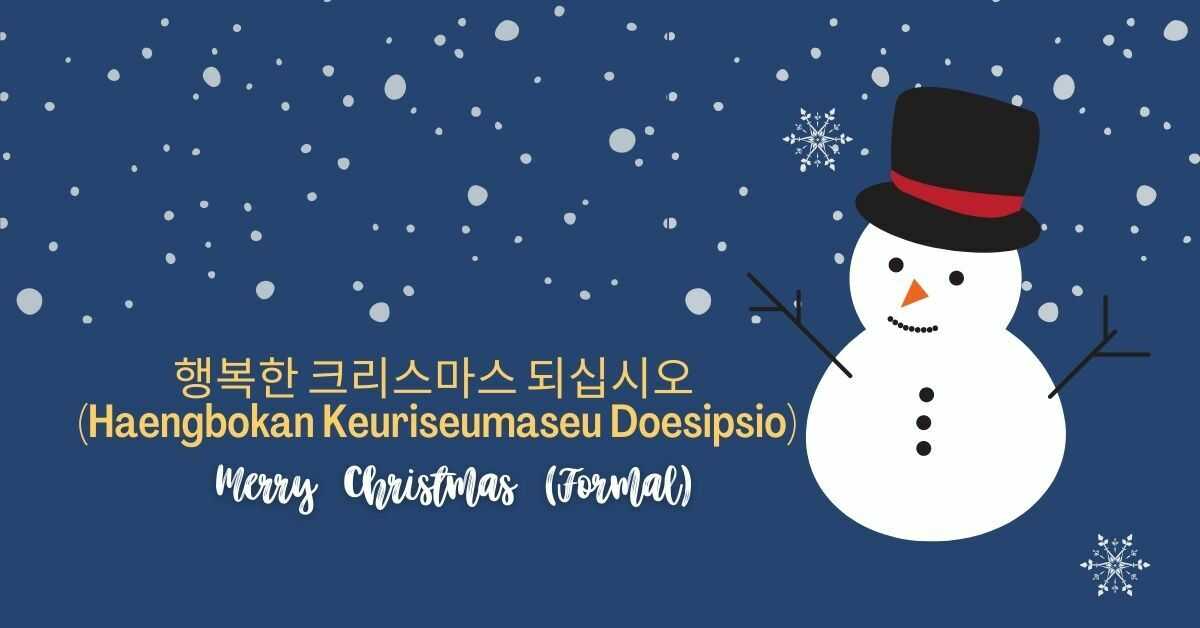
1. Merry Christmas – Haengbokan Keuriseumaseu Doesipsio (행복한 크리스마스 되십시오)
If you are new to Korean culture and still don’t have a strong grasp of the language, it is safest to use the formal version. This is the most formal Korean Christmas greeting and can be used for people of all ages.
The word Haengbokada (행복하다) means “happy,” and Keuriseumaseu (크리스마스) means “Christmas.” Notice the Korean ending –Sipsio (–십시오), which is what makes the greeting very polite. You will often see this form used on cards and posters.
2. Merry Christmas – Jeulgeoun Seongtanjeol Bonaesipsio (즐거운 성탄절 보내십시오)
Another formal Korean Christmas greeting to learn is Jeulgeoun Seongtanjeol Bonaesipsio (즐거운 성탄절 보내십시오). Let’s break down what the words mean. Jeulgeopda (즐겁다) means “pleasant,” Seongtan (성탄) means “the sacred birth,” and Seongtanjeol (성탄절) means “Christmas.” This is a perfect phrase to use even when you are not in a highly formal situation.
Informal Korean Christmas Greetings
The informal form of spoken Korean is used with people your own age, close friends, or when both parties have agreed to speak casually. Here are some informal Korean Christmas greetings to know.
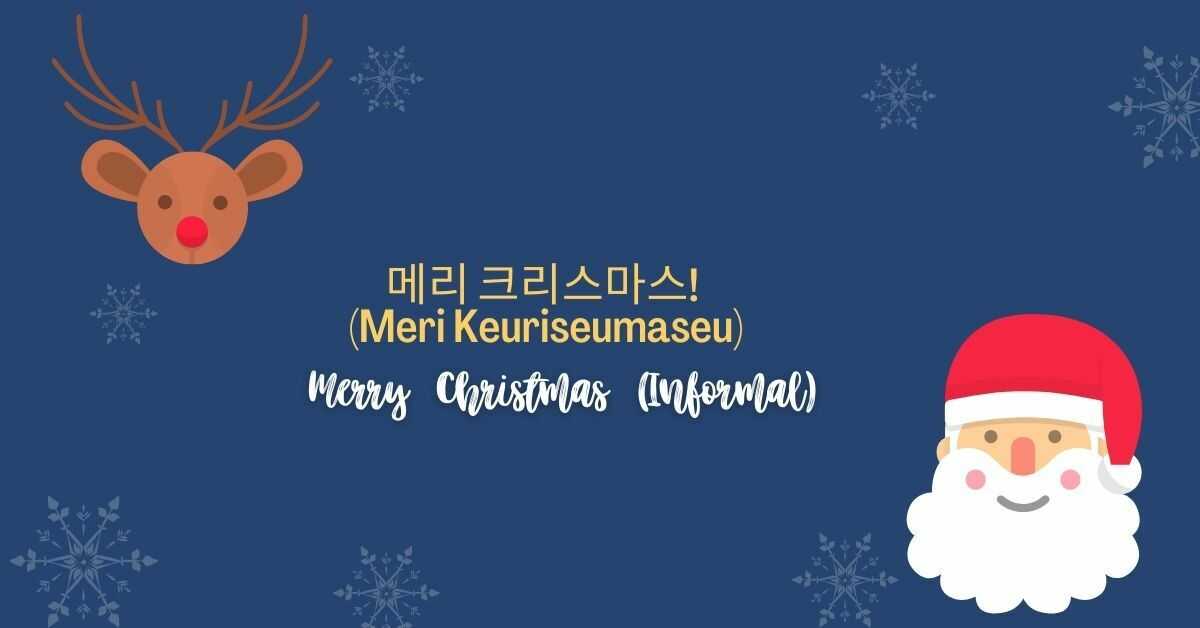
1. Merry Christmas – Meri Keuriseumaseu (메리 크리스마스! )
This is the easiest Korean Christmas greeting for foreigners to learn because it is very close to the English translation. However, you should know that it is also widely used in Korea. Since it comes directly from English, it does not include a politeness marker, so it is not considered strictly informal.
2. Merry Christmas – Keuriseumaseu Jal Bonae(크리스마스 잘 보내)
This is the informal version of the first standard Korean Christmas greeting. Notice the missing ending character, which normally indicates politeness.

Korean Culture During The Holiday Season
You know it’s the Christmas season in South Korea when Santa Claus appears everywhere, Christmas lights shine across the streets, and shopping malls are full of discount sales.
Of course, the season wouldn’t be complete without Christmas songs from K-pop idols, like IU’s cover of Santa Tell Me, Twice’s Merry, Happy, EXO’s What I Want for Christmas, and BTS’s version of Santa Claus Is Comin’ to Town. But in South Korea, Christmas isn’t just about religion.
Christianity only arrived in Korea in the 17th century, and no single religion dominates the country today. About 46% of South Koreans don’t identify with any religion, while Christians make up 29% and Buddhists 23%. With so many Christians, it’s no surprise that the festive spirit is very much alive during the holiday season.
Christmas in South Korea is an official national holiday, making it the only East Asian country to recognize it officially. Even in North Korea, where religion is restricted, Christmas is just an ordinary day. Most South Koreans spend the holiday with friends or partners rather than traveling to their families in the provinces. Some even jokingly call it “another Valentine’s Day with Santa.”
Preparations begin in November. Unlike the Philippines, which has the longest Christmas season in Asia, starting in September, Korea keeps the celebration shorter since September is still autumn. Because Christmas is a public holiday, there’s no extended Christmas vacation. Students and teachers return to school on December 26, and most employees go back to work as well.
During this festive time, exchanging gifts and sharing warm Korean Christmas greetings are common ways to spread holiday cheer among friends and loved ones.
Korean Christmas Food
Traditional Christmas dishes aren’t really part of Korean cuisine. If you’re craving a Western-style Christmas meal, you can usually find restaurants that serve it, especially in areas like Itaewon.
But since you’re in South Korea, why not celebrate Christmas the Korean way? You can enjoy some classic Korean winter dishes that are perfect for the season, such as:
| English | Hangul | Romanization | Sound |
|---|---|---|---|
| Korean Sweet Pancakes | 호떡 | Hotteok | |
| Goldfish Bread | 붕어빵 | Bungeo-Bbang | |
| Spicy Stir-Fried Rice Cakes | 떡볶이 | Tteokbokki | |
| Fish Cake | 오뎅 | Odeng | |
| Kimchi Stew | 김치찌개 | Gimchijjigae | |
| Braised Beef Short Ribs | 갈비찜 | Galbi Jjim |
Korean Christmas Songs
The Christmas season wouldn’t be complete without traditional songs and carols. In Korea, no one delivers them quite like award-winning K-pop idols. Many groups and solo artists release Christmas songs focused on themes of love, giving, and sharing.
These tracks are played everywhere, from shopping malls to parks and other public spaces. You can also hear Western Christmas classics covered by K-pop artists, like IU and BTS, adding a festive touch to the holiday atmosphere.
Korean Christmas Decorations
One of the best ways to feel the spirit of Christmas in Korea is through the decorations. Many Korean families set up their own Christmas trees at home, while buildings and houses outside are adorned with sparkling lights. The large trees in shopping centers are beautifully decorated and often become festive landmarks.
Christmas decorations in South Korea are generally affordable, and you can find them easily at local stores, making it simple to bring some holiday cheer into your own space.
Christmas Gifts In South Korea
Koreans usually do not go overboard in buying Christmas gifts for everyone. However, if you have the budget, this is a great time to shop because most malls offer holiday sales. If not, sending a Christmas card is enough to show your loved ones that you remembered them during the holiday season. The themes of Korean Christmas cards often feature nature, symbolizing peace and warmth.
How To Have A Fun And Nice Christmas In South Korea
Even though Christmas is not as widely celebrated in Korea as in other countries, Koreans have their own ways of making the holiday special with family, friends, and partners. Here are some fun ideas to try:
- Visiting theme parks and amusement parks.
- Ice skating and sledding.
- Shopping.
- Going to parties.
- Exploring fairs and markets.
Korean Christmas And Holiday Vocabulary
Of course, this lesson will not be complete without learning some Christmas and holiday vocabulary in Korean.
| English | Hangul | Romanization | Sound |
|---|---|---|---|
| Gift / Present | 선물 | Seonmul | |
| Christmas lights | 줄타기 | Jultagi | |
| Christmas tree | 초록나무 | Choroknamu | |
| Christmas carol | 송정 | Songjeong | |
| Santa Claus | 산타클로스 | Santa Claus | |
| Christmas dinner | 성탄절 저녁 | Seongtanjeol Jeonyeok | |
| Wrapping paper | 페이퍼 플래잉 | Peipeo Peulajang | |
| End of Christmas / Christmas finale | 성탄절 끝 | Seongtanjeol Kkeute | |
| Happy New Year | 해피 뉴 이어 | Haeppy New Year | |
| Christmas welcome / greeting | 성탄절 환영 | Seongtanjeol Hwanyeong |
How Do You Say ‘Christmas Greetings’ In Korean?
“Christmas greetings” in Korean can be expressed as keuriseumaseu insa (크리스마스 인사).
Tips To Learn Korean Phrases More Easily
Now that you know several Korean Christmas greetings, the next step is to make them stick. Learning a few phrases is fun, but remembering and using them in real life takes a bit of strategy. Here are some practical ways to get Korean phrases into your memory:
- Focus on Korean greetings or phrases you’re likely to say in real life, like Korean Christmas greetings. Using language that’s relevant keeps your learning meaningful and motivates you to remember it.
- Spend time hearing how native speakers say the phrases before trying to repeat them. Even a few minutes of listening to Christmas songs or short clips can give you the right rhythm and tone.
- Korean learners often stall at trying to sound perfect. Just saying a phrase out loud, even if it’s a little rough, helps you remember it and builds confidence faster than endless repetition.
- Look out for repeated parts in phrases. For instance, many greetings end with seyo (–세요) for politeness. Recognizing patterns helps you understand and create new phrases more easily.
- Use sticky notes, phone reminders, or small conversations to insert phrases into your daily routine.
Frequently Asked Questions About Christmas In Korea
What Does ‘Saehae Bok Mani Badeuseyo’ Mean?
Saehae Bok Mani Badeuseyo (새해 복 많이 받으세요) means “Wishing you lots of luck in the new year.”
What Do They Call Santa Claus In South Korea?
In South Korea, Santa Claus is most often called Santa Harabeoji (산타할아버지). This translates to “Grandfather Santa.” You’ll also hear the direct English loanword Santa Kulloseu (산타클로스).
Is Christmas A Good Time To Visit South Korea?
Yes, especially if you enjoy festive lights, cool weather, and a unique cultural take on the holidays. It’s a national holiday, so the atmosphere in major cities is lively with decorations, light festivals, and markets.
However, it’s a very popular travel period. Hotels in popular areas book up quickly, and nice restaurants (which are often busy with couples on dates) require reservations well in advance. Also, be prepared for real winter cold, with temperatures often around or below freezing.
What Is The Best Place To Celebrate Christmas In South Korea?
The “best” place depends on what you’re looking for. Seoul is the festive heart of the country, with incredible light displays, department store decorations, Christmas markets, and outdoor ice rinks.
Busan offers a slightly milder coastal climate and its own spectacular events. For stunning natural scenery lit up for the season, day trips to places like the Garden of Morning Calm for its Lighting Festival are highly recommended.
And if you dream of a snowy Christmas, heading to ski resorts in Gangwon-do province (like Pyeongchang) can be a great idea.
Wrapping Up Korean Christmas Greetings
In this article, we explored how Christmas is celebrated in South Korea and introduced useful Korean vocabulary and expressions related to the holiday. We covered different levels of formality in the language and explained how politeness affects communication, along with additional Christmas-related words to expand your vocabulary.
We also shared practical tips for learning Korean phrases and answered common questions for learners, including how to approach the language and understand polite expressions.
With a bit of practice, you can use these tips to improve your Korean and enjoy the holiday season.
Wanna Learn More Aside From Merry Christmas In Korean?
If you’re ready for another adventure in your language learning journey, the Ling app has plenty more lessons for you. But these aren’t just any lessons; they are interactive and meaningful experiences designed to help you improve your Korean language skills.
With a variety of lessons paired with engaging activities, you can start learning Korean on your own in a short time. On the Ling app, lessons are presented as fun, engaging minigames with native-speaker audio. There are also quizzes and challenges to test your knowledge and skills. The best part is you can download the app to your phone, so your lessons can go wherever you go.
There’s so much to explore in the Korean language. Start learning Korean with the Ling app today!