When we want to talk about the Taiwanese alphabet, we have to ask an important question: Which one? You see, there are many ways in which Taiwanese Hokkien can be written.
That’s why this blog will be a bit different. Instead of focusing on a single alphabet, we will introduce you to the six different writing systems of Taiwanese. You’ll also learn why each system exists and how it can help you with learning the language to connect more easily with your family.
Taiwanese Characters Explained
Taiwanese Hokkien, also called Tâi-gí, Hoklo, or Southern Min, is a variety of Min Nan spoken in Taiwan and is one of the many Chinese languages. It comes from the language of southern Fujian in China, especially the Xiamen dialect, brought over by the ancestors of the Taiwanese people.

Why Are These So Many Writing Systems In Taiwan?
The Taiwanese language has been influenced by different groups and purposes over time. Taiwanese Hokkien was originally only a spoken language, so there were multiple systems created to help people read, write, and learn it.
Unlike Mandarin, Taiwanese Hokkien doesn’t rely on a single standard writing system. In daily life, it’s usually written with traditional Chinese characters, while Romanization systems are used for learning, pronunciation, and vernacular writing.
Each Taiwanese script reflects a different approach to writing the sounds and tones in Taiwanese. Let’s learn about each one in more detail!
1. The Latin Taiwanese Alphabet – Pe̍h-ōe-jī
Pe̍h-ōe-jī, or POJ, is the most common way of writing Taiwanese Hokkien using the Latin alphabet.
This writing system was created by Western missionaries in the 19th century and became popular for writing newspapers and books. POJ uses special marks to show tones, which are very important, because changing the tone can change the meaning of the word.
POJ is phonetic, which makes it easier to learn. You only need to know 26 letters and a few tonal marks, instead of thousands of characters like standard Chinese writing.
Each letter also has a spoken name that helps with pronunciation. Some represent single sounds, while others combine letters to show specific Taiwanese sounds. These names make spelling, reading aloud, and learning pronunciation much more straightforward.
| Capital letter | Lowercase letter | Name of the letter |
|---|---|---|
| A | a | a |
| B | b | be |
| CH | ch | che |
| CHH | chh | chhe |
| E | e | e |
| G | g | ge |
| H | h | ha |
| I | i | i |
| J | ji̍t | ji̍t |
| K | k | ka |
| KH | kh | kha |
| L | l | é-luh |
| M | m | é-muh |
| N | n | é-nuh |
| ᴺ | ⁿ | iⁿ |
| NG | ng | ng |
| O | o | o |
| O͘ | o͘ | o͘ |
| P | p | pe |
| PH | ph | phe |
| S | s | e-suh |
| T | t | te |
| TH | th | the |
| U | u | u |
2. Standard Chinese Characters
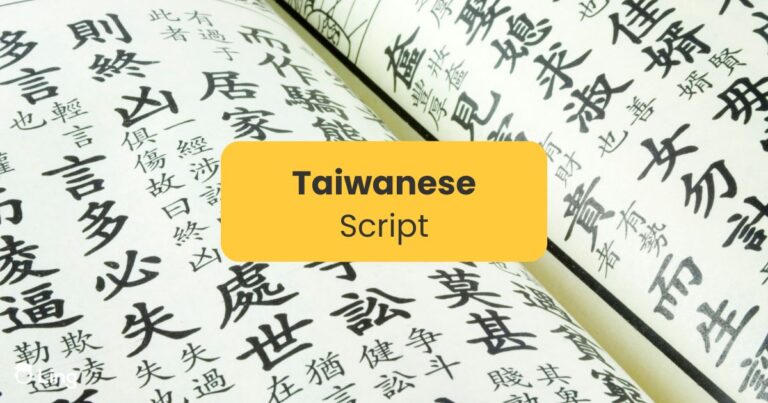
Taiwanese Hokkien is often written using traditional Chinese characters. They are the same as the ones used for Mandarin. However, since Taiwanese developed mainly as a spoken language, many common words don’t have a single agreed-upon character.
That is why many people often mix Chinese characters with Romanization or Bopomofo to show pronunciation. This is also one of the main reasons why there are multiple writing systems in Taiwanese.
Not to mention, standard Chinese has over 50,000 characters, which is also why Taiwanese people decided to simplify it!
3. Taiwanese Romanization System (Tâi-lô)
The Taiwanese Romanization System, or Tâi-lô, is the official way to write Taiwanese and has been promoted by Taiwan’s Ministry of Education since 2006.
It is based on POJ and uses the Latin alphabet with tone marks to show pronunciation clearly. Tâi-lô uses 16 basic letters along with a few letter combinations to represent specific sounds, and “nn” after vowels to show nasal sounds.
For learners today, it is one of the easiest systems to read and write, and it works well for everyday communication.

4. Taiwanese Language Phonetic Alphabet
The Taiwanese Phonetic Transcription system also uses Latin letters to represent sounds. It is based on an older Romanization system for Mandarin called Tongyong Pinyin. This system makes it easier to spell out Taiwanese words, but it is less commonly used outside learning materials and textbooks.
5. Modern Literal Taiwanese
Modern Literal Taiwanese (MLT) uses only the standard letters of the Latin alphabet and avoids any special marks. Instead, it shows tones by changing spelling patterns. This makes it simpler to type and read, especially on computers.
MLT was developed in 1945 and is based on POJ, keeping the same basic ideas while simplifying the visual style.
6. Bopomofo (Zhuyin)
Extended Bopomofo, also called Zhuyin, is a phonetic system that uses unique symbols instead of letters to show how words sound.
It is used in schools, for typing, and in literature to represent Hokkien-specific words or to show the Taiwanese pronunciation of Chinese characters. Each symbol represents a sound, which helps learners read and speak Taiwanese more accurately and to better understand pronunciation.
Examples Of Each Alphabet
So, how would each of the writing systems look? Let’s take this sentence example: “I am learning Taiwanese.”
- Traditional Chinese characters: 我正在學台語。
- Pe̍h-ōe-jī: Guá tī-tsīng ha̍k Tâi-gí.
- Tâi-lô: Guá tī-tsìng ha̍k Tâi-gí.
- Taiwanese Phonetic Transcription system: Gua ti-zhing hak Tai-gi.
- Modern Literal Taiwanese: Gua ti-tsing hak Tai-gi.
- Bopomofo/Zhuyin: ㄨㄛˇ ㄓㄥˋ ㄗㄞˋ ㄒㄩㄝˊ ㄊㄞˊ ㄩˇ
How Do You Say “Alphabet” In Taiwanese?
In Taiwanese, “alphabet” is usually jī-bú (字母). This is the most general term for the alphabet or the letters themselves. You can use this when talking about the Latin alphabet or any set of letters.
To say Taiwanese alphabet you can say tâi-gí jī-bú.
Basic Taiwanese Words
When reading Taiwanese, you’ll often see words written in Chinese characters, sometimes with Romanization to show pronunciation. Here are some basic, everyday words to get you started:
| English | Chinese Characters | Pe̍h-ōe-jī |
|---|---|---|
| family | 家庭 | ka-tîng |
| mother | 阿母 | a-bú |
| dad | 阿爸 | a-pah |
| dog | 狗 | káu |
| cat | 貓 | niau |
| apple | 蘋果 | phông-kó |
| banana | 弓蕉 | king-tsio |
| eye | 目 | ba̍k |
| hand | 手 | tshiú |
| hair | 頭毛 | thâu-mn̂g |
Tips For Learning Taiwanese Writing
How to even go about learning so many new writing systems? Here are a few tips to help you out when it comes to Taiwanese letters:
- Start with Tâi-lô Romanization to get the sounds and tones right before diving into the Chinese characters.
- Practice one Romanization writing system at a time to avoid confusion.
- Practice writing common words with a Romanization system and eventually match them to their Chinese characters. Start with simple ones like hello in Taiwanese, which is Lí-Hó but also written as 你好.
- Compare the same word in POJ, Tâi-lô, and Bopomofo to understand how different systems represent sounds.
- Write words aloud while saying them so your hand and mouth learn together.
- Keep a mini-journal in Romanized Taiwanese to track Taiwanese phrases and words you use in everyday life.
- When learning Zhuyin, trace the symbols while saying the sounds to memorize the letters.
- Listen to Taiwanese audio to hear how words are spoken naturally with the writing. You can use the Ling app for this as well!

Frequently Asked Questions About The Taiwanese Alphabet
What Alphabet Is Used In Taiwan?
Taiwanese Hokkien is mainly written using Latin-based alphabets like Pe̍h-ōe-jī or Tâi-lô. Chinese characters are also used for Hokkien, but only partially and sometimes with special characters. Bopomofo is used as a phonetic guide for pronunciation.
How Is Taiwanese Writing Different From Chinese?
Chinese is written using Chinese characters only, either simplified or traditional. Taiwanese, on the other hand, is written with traditional characters and Latin alphabet based systems. These different alphabets make it easier to read, pronounce, and write everyday Taiwanese.
What Is Bopomofo?
Bopomofo is a phonetic language system used in Taiwan to show how words are pronounced. Children in Taiwan learn Bopomofo in elementary school to help them read Chinese characters. It uses its own set of symbols, so you can often see them written next to characters in books as a pronunciation guide.
What Writing Should I Focus On For Learning Taiwanese Hokkien?
Hokkien doesn’t have just one way of being written, which makes the Taiwanese alphabet unique.
People in Taiwan use traditional Chinese characters, Latin-based systems like Pe̍h-ōe-jī and Tâi-lô, and the phonetic Bopomofo to explain pronunciation.
The main takeaway of this post is that if you want to read, write, or speak Taiwanese, you should learn all of these systems. It’s best to start simple with romanization, but learning some traditional characters and Bopomofo will give you a more complete picture of how the language works.
Learn From Practical, Real-Life Examples!
Want to take the easy approach to learning Taiwanese Hokkien? With the Ling app, you can do exercises where you get to see Taiwanese phrases written in both Chinese characters and the Latin alphabet! You’ll also get practical examples that show how the language is actually used, so you can speak naturally with family, friends, or locals.
Practice at your own pace and track your progress with lessons that connect letters, tones, and meaning. Download the Ling app today and start learning Taiwanese Hokkien the smart way!